
If you were hurt in a crash involving a Tesla on Autopilot, a car using lane-keeping or adaptive cruise control, or a self-driving test vehicle in New Jersey, the question is not only "who was driving?" but "what was the car doing?" The answer usually lives in the vehicle's own data, and that data can disappear fast. This guide explains who can be responsible, which New Jersey laws apply, and what to do in the first days after the crash.
Quick answer
In most New Jersey crashes involving "self-driving" features, the human driver is still legally responsible, because today's systems require the driver to supervise. The automaker or software company can also be responsible under the New Jersey Products Liability Act (N.J.S.A. 2A:58C-1 and following) if a design defect, manufacturing defect or poor warning helped cause the crash. You generally have two years to file (N.J.S.A. 2A:14-2), but the vehicle data should be preserved right away.
Is the car actually "self-driving"? The six levels
Engineers and regulators use the SAE J3016 scale to describe automation. Where a vehicle sits on this scale shapes who is expected to be watching the road.
| Level | What it means | Who must watch the road |
|---|---|---|
| 0 | No automation. Warnings only, such as a blind-spot alert. | The driver |
| 1 | Driver assistance: steering or speed, such as adaptive cruise control. | The driver |
| 2 | Partial automation: steering and speed together. Tesla Autopilot and Full Self-Driving (Supervised), GM Super Cruise and Ford BlueCruise are marketed as Level 2. | The driver, at all times |
| 3 | Conditional automation: the car drives in limited conditions and asks the driver to take over when needed. | The system, until it requests takeover |
| 4 | High automation: no driver needed inside a defined area, such as a robotaxi service zone. | The system |
| 5 | Full automation everywhere. No such vehicle is sold to the public. | The system |
Nearly every "self-driving" car on New Jersey roads today is Level 2. That matters: the owner's manual tells the driver to keep hands on the wheel and eyes on the road, so a driver who relies on the system and looks away is usually negligent in the same way as any distracted driver.
Who can be responsible for a self-driving car crash in New Jersey
- The driver. New Jersey's motor vehicle laws apply to a person operating a car with driver-assist engaged. Following too closely, careless driving (N.J.S.A. 39:4-97) and handheld phone use (N.J.S.A. 39:4-97.3) are still violations.
- The vehicle owner, through the owner's insurance policy, and in some cases an employer whose employee was driving for work.
- The manufacturer. Under N.J.S.A. 2A:58C-2, a manufacturer or seller is liable if a product was not reasonably fit, suitable or safe because of a manufacturing defect, a design defect, or inadequate warnings or instructions.
- A software or sensor supplier, if a component it made was defective.
- A testing or robotaxi company, for its safety driver's negligence and its own decisions about training, monitoring and when to deploy. See who is liable when a self-driving backup driver crashes.
- Another driver who caused or contributed to the collision.
New Jersey's comparative negligence law (N.J.S.A. 2A:15-5.1) lets a jury split fault among all of these parties. An injured person can recover as long as they are not more than 50% at fault, with the award reduced by their own share. See how comparative negligence works in New Jersey.
How a driver-assist product defect claim works
Product cases look at the car itself, not just the driver's choices. Common theories in automation cases include:
- Design defect: the system failed to detect a stopped emergency vehicle, a crossing truck or a pedestrian that a reasonably designed system would have detected, or it allowed use on roads it was not built for.
- Weak driver monitoring: the system let a driver look away or take hands off the wheel for long periods without effective warnings.
- Warning and marketing claims: names, ads or statements that led drivers to believe the car could drive itself, when the fine print said otherwise.
- Software failure: sudden "phantom" braking, unintended steering or an over-the-air update that changed how the car behaves.
Federal regulators have taken these issues seriously. In December 2023 Tesla recalled roughly two million vehicles in the United States after a National Highway Traffic Safety Administration (NHTSA) investigation into whether Autopilot's driver-monitoring controls were adequate. A recall does not prove a defect caused any particular crash, but it can be important evidence.
Juries have also held manufacturers partly responsible. In August 2025, a federal jury in Miami found Tesla one-third responsible for a 2019 Florida crash in which a driver using Autopilot ran through an intersection, and awarded damages that included punitive damages. Tesla said it would appeal. Every case turns on its own facts, but the verdict shows that "the driver should have been paying attention" does not automatically end a product claim.
The evidence that wins these cases, and why it disappears
A driver-assist crash case is built on data. Key sources include:
- Event data recorder (EDR): the "black box" that records speed, braking, throttle and seatbelt use in the seconds around a crash. Federal rules at 49 C.F.R. Part 563 set what EDRs in many vehicles must capture.
- System logs: whether automation was engaged, when it warned the driver, whether hands were detected on the wheel, and when it disengaged. Some automakers upload this data to their own servers.
- Camera footage: many cars with driver-assist record from multiple cameras.
- NHTSA crash reports: under NHTSA's Standing General Order on crash reporting, manufacturers and operators must report certain crashes involving Level 2 systems and automated driving systems. Reports are published in a public database, with some details redacted.
- The police report: since the 2023 edition of the NJTR-1 crash report, Boxes 150 to 153 record driver-assist and automation information. See how to read a New Jersey police crash report.
Cars get repaired, totaled, sold at auction or crushed. Onboard data can be overwritten. A prompt written preservation letter to the owner, insurer, manufacturer and tow yard helps protect the evidence, and New Jersey courts can sanction a party that destroys evidence it knew was relevant to likely litigation.
Whose insurance pays first
New Jersey is a no-fault state. Your own auto policy's Personal Injury Protection (PIP) usually pays your medical bills first, regardless of whether a driver, a manufacturer or software was at fault (N.J.S.A. 39:6A-4). If you have no auto policy, other rules decide which policy pays. See our New Jersey PIP FAQs.
To sue an at-fault driver for pain and suffering, you may need to meet the "verbal threshold" if your policy has the limitation-on-lawsuit option. See the serious injury threshold. A product claim against a manufacturer is a different kind of claim, and the auto-insurance verbal threshold generally protects only those covered by New Jersey's auto insurance law, not carmakers. Whether that applies to your case should be reviewed by a lawyer.
If the vehicle was carrying a passenger through a rideshare app, New Jersey's Transportation Network Company Safety and Regulatory Act requires $1.5 million in coverage during a trip (N.J.S.A. 39:5H-10). See who is liable in an Uber accident.
Are self-driving cars legal in New Jersey?
Driver-assist features such as Autopilot are legal to use in New Jersey because a licensed driver remains in control. As of this writing, New Jersey has not enacted a law authorizing fully driverless vehicles to carry the public on its roads, although bills on autonomous vehicle testing have been introduced in the Legislature. Federal safety standards for vehicle design are set by NHTSA, while New Jersey sets the rules for drivers, licensing and insurance. When the law changes, the basic negligence and product liability rules described above will still apply.
What to do after a crash involving driver-assist or a self-driving car
- Call 911 and get medical care. Some injuries, including concussions, show up hours later.
- Tell the officer if you believe a driver-assist system was engaged, so it is noted on the report.
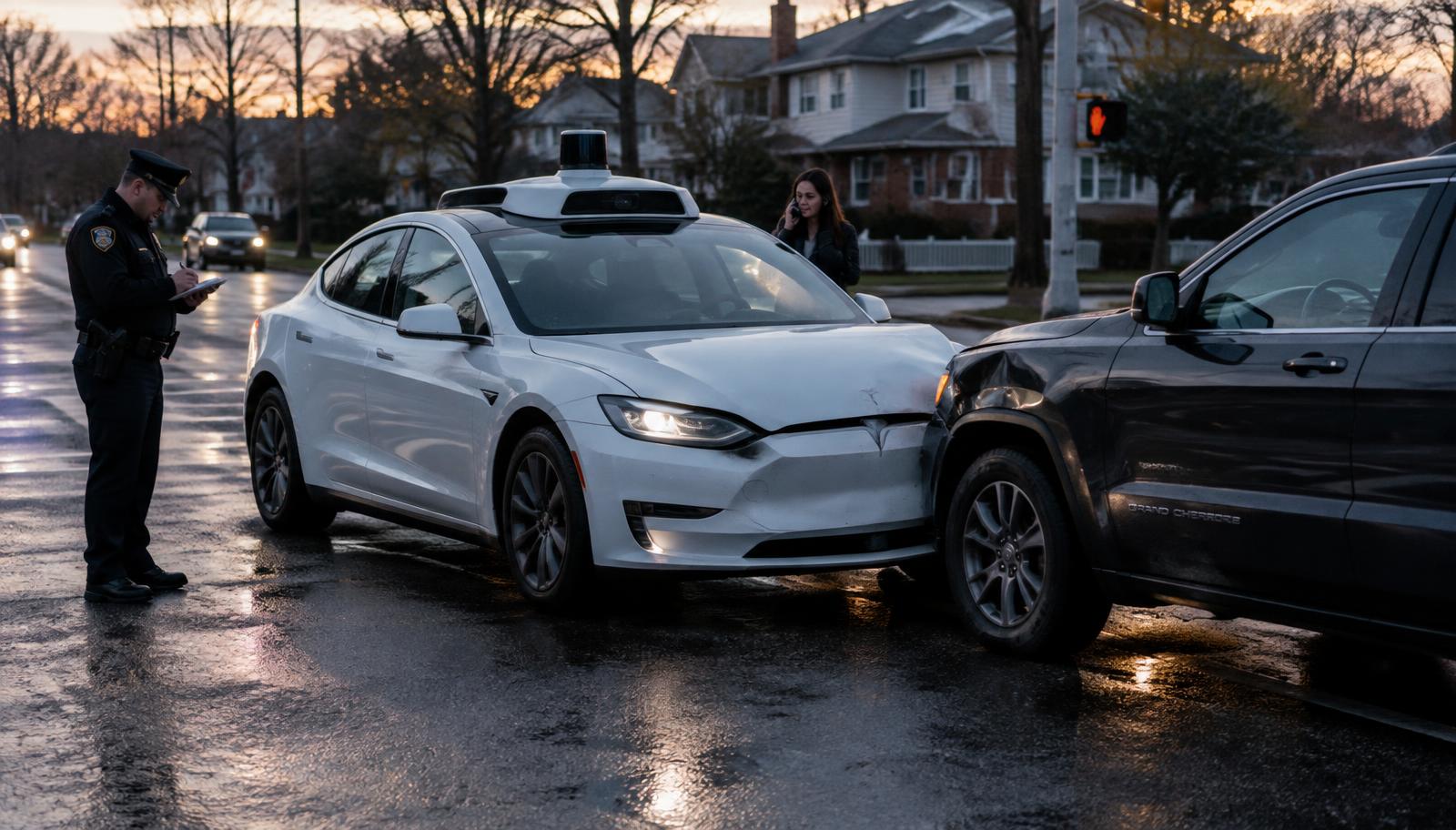
- Photograph both vehicles, including roof or bumper sensors, the dashboard screen if visible, and any company markings on a test vehicle.
- Write down what the other driver said, such as "the car was driving" or "Autopilot was on." Statements like this can be important.
- Do not give a recorded statement to the other driver's insurer or the automaker before getting advice. See what not to tell an insurance company.
- Do not let your own car be repaired or scrapped if it has driver-assist and may hold data, until a lawyer has advised you.
- Get a lawyer to send preservation letters quickly to protect EDR, log and camera data.
- Mind the deadline: two years for most injury claims (N.J.S.A. 2A:14-2), and as little as 90 days to file a notice of claim if a public entity is involved (N.J.S.A. 59:8-8).
What compensation may be available
Depending on the facts, an injured person may recover medical expenses beyond PIP, lost wages and earning capacity, pain and suffering, and, for families, wrongful death damages. Punitive damages are allowed in New Jersey only on clear and convincing proof of actual malice or wanton and willful disregard, and are generally capped at five times compensatory damages or $350,000, whichever is greater (N.J.S.A. 2A:15-5.12 and 5.14). See how much a car accident claim is worth.
Frequently asked questions
If the car was on Autopilot, is the driver still at fault?
Usually yes, at least in part. Autopilot and similar systems are Level 2 driver-assist features that require constant supervision. The manufacturer can share fault if the system was defective or its warnings were inadequate.
Can I sue Tesla or another automaker after a crash in New Jersey?
Yes, if the evidence shows a defect in the vehicle's design, manufacture or warnings helped cause your injuries. These claims proceed under the New Jersey Products Liability Act and typically require engineering experts and the vehicle's data.
How do I find out if driver-assist was turned on?
Through the vehicle's event data recorder and system logs, the police report (Boxes 150 to 153 on the NJTR-1), witness statements and, in some cases, NHTSA's public crash report database. A lawyer can demand the data in discovery.
I was a pedestrian or cyclist hit by a self-driving car. What are my rights?
You can generally claim against the driver, the owner's insurance and, where a defect is involved, the manufacturer. Your own or a household member's auto policy may provide PIP first. See pedestrian right of way in New Jersey.
How long do I have to file?
Generally two years from the crash under N.J.S.A. 2A:14-2. Claims involving public entities require a notice of claim within 90 days. Evidence preservation should start immediately.
For a free review of a crash involving Autopilot, driver-assist or a self-driving test vehicle, see our New Jersey self-driving car accident lawyer page or request a free consultation.
Sources
- N.J.S.A. 2A:58C-1 to -11 (New Jersey Products Liability Act)
- N.J.S.A. 2A:15-5.1 (comparative negligence); N.J.S.A. 2A:15-5.9 to -5.17 (Punitive Damages Act)
- N.J.S.A. 2A:14-2 (statute of limitations); N.J.S.A. 59:8-8 (Tort Claims Act notice)
- N.J.S.A. 39:6A-4 (PIP); N.J.S.A. 39:5H-10 (rideshare insurance); N.J.S.A. 39:4-97, 39:4-97.3
- SAE International, J3016 Levels of Driving Automation
- NHTSA, Standing General Order on Crash Reporting; NHTSA Recall 23V-838 (Tesla Autopilot)
- 49 C.F.R. Part 563 (Event Data Recorders)
- NJDOT, NJTR-1 Crash Report Manual, Edition 2.0 (2023)