
After a crash in New Jersey, the officer fills out a standard form called the NJTR-1, the New Jersey Police Crash Investigation Report. It is made of 153 numbered boxes, most of them filled with two-digit codes. This guide shows the official form page by page, decodes every important box with the official codes and diagrams from the State's NJTR-1 Crash Report Manual, explains how to get your report in any town, and shows what to do if something on it is wrong.
Quick answer: how to read a NJ police crash report
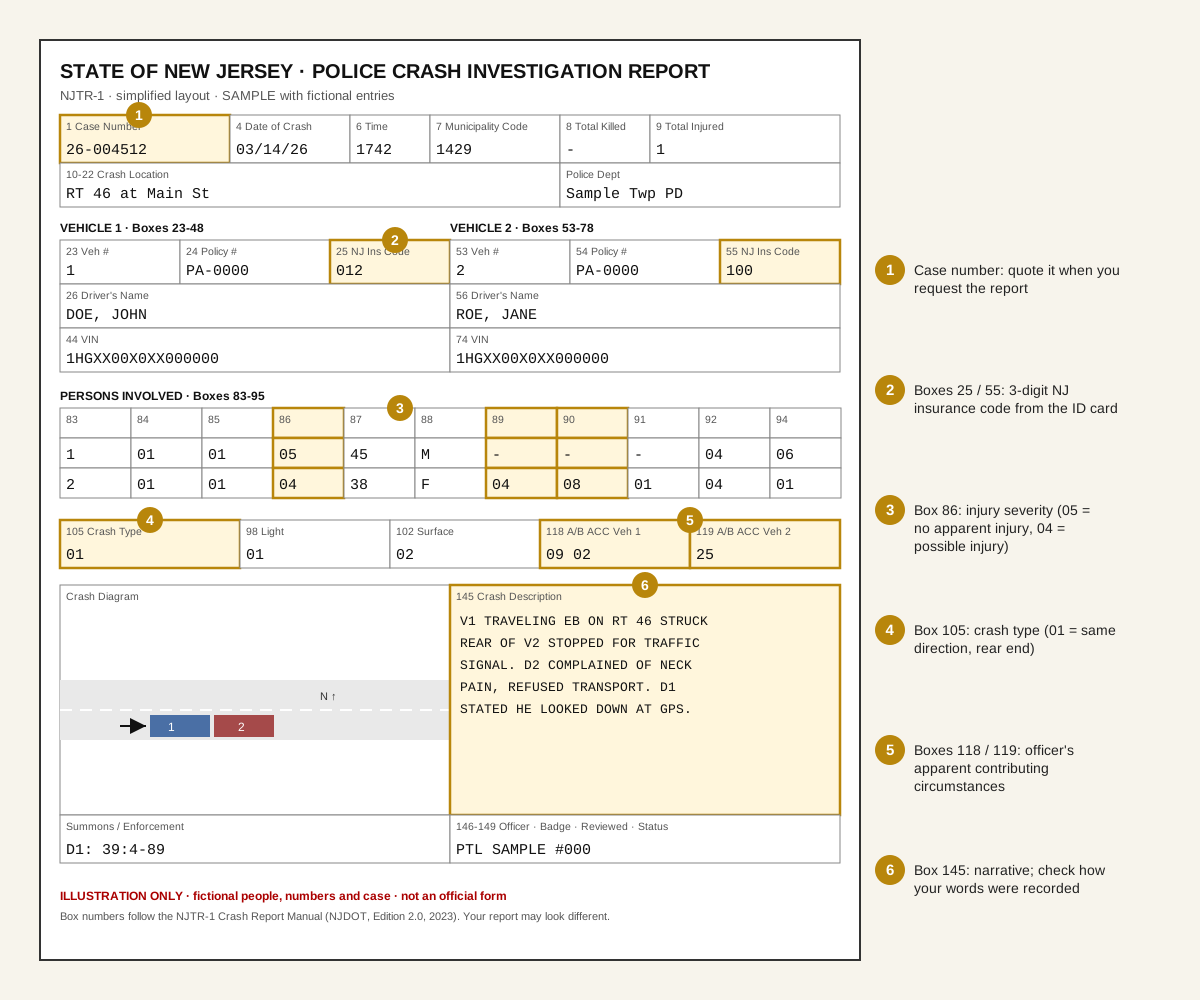
Start with the case number, date and location (Boxes 1 to 22). Check each driver, plate, policy number and the three-digit insurance code in Box 25 and Box 55. Find your injury row in Boxes 83 to 95, where Box 86 is the injury severity. Then read the contributing circumstance codes in Boxes 118 and 119, the diagram, and the officer's narrative in Box 145. Fix factual errors quickly with the police department.
Video coming soon
Dennis explains your NJ crash report
A short walkthrough of the boxes that matter most after a crash. Until it is posted, the guide below covers everything in the video.
Key facts
- Drivers must report a crash that causes injury, death or property damage over $500 (N.J.S.A. 39:4-130), and the officer must file the NJTR-1 within five days of the investigation (N.J.S.A. 39:4-131).
- Every police agency in New Jersey uses the same form. The current version took effect January 1, 2023 and has 153 boxes.
- State Police, Turnpike and Parkway reports cost $13 (or $5 for toll roads) online and can take up to 14 business days.
- The officer's codes are evidence, but they do not decide fault in an injury case.
What is a police accident report?
A police accident report is the written record an officer makes after investigating a crash. In New Jersey, the officer who responds, whether from the town police, a county agency or the State Police, completes the NJTR-1 and must file it within five days of the investigation. The report records who was involved, the vehicles, the insurance, injuries seen at the scene, the road conditions, a diagram and a short narrative. Insurance adjusters, lawyers and courts use it as a starting point to understand what happened and who to contact. It is important to know what it is not: the report is the officer's account, built from what they saw and what people told them. It is not a finding of legal fault.
How to read a police report, step by step
Every New Jersey police agency uses the same NJTR-1 form, so the same seven steps work for any report, whether it came from a town police department or the State Police. Keep the report, your photos and your insurance card in front of you.
- Confirm it is your crash. Check the case number, date, time, town and exact location in Boxes 1 to 22. Make sure the cross street and direction of travel are right. See the details.
- Find each driver, owner and insurer. Read the Vehicle 1 boxes (23 to 48) and Vehicle 2 boxes (53 to 78). Box 25 and Box 55 hold the three-digit New Jersey insurance company code for each vehicle. See the details.
- Check for a truck, bus or rideshare. Boxes 49 to 52 and 79 to 82 are filled in only for commercial vehicles and name the motor carrier. Code 21 in Box 112 or 113 means the officer saw an Electronic Ride Share vehicle. See the details.
- Find your row in the people table. Each person has one row in Boxes 83 to 95. Box 86 is the officer's view of injury severity, and Boxes 89 and 90 are the location and type of the most severe injury. See the details.
- Read the codes that describe the crash. Boxes 96 to 103 cover the road, light and weather, Box 105 is the crash type, and Boxes 129 to 134 show where each vehicle was hit and how badly it was damaged. See the details.
- Read the officer's opinion of the cause. Boxes 118 and 119 list up to two contributing circumstances for each driver, Boxes 120 and 121 record each driver's apparent condition, and Boxes 136 to 143 list any summonses. See the details.
- Read the diagram and narrative last. Compare the Box 144 diagram and the Box 145 narrative with what happened. The narrative should summarize each driver's and witness's account and list witness contact details. See the details.
If anything is wrong, use the correction steps below right away, before the insurers rely on it.
What a police accident report looks like
The NJTR-1 is a dense form. It helps to see it as eight zones, each with a job. The diagram below shows a blank form with the zones numbered 1 to 8.
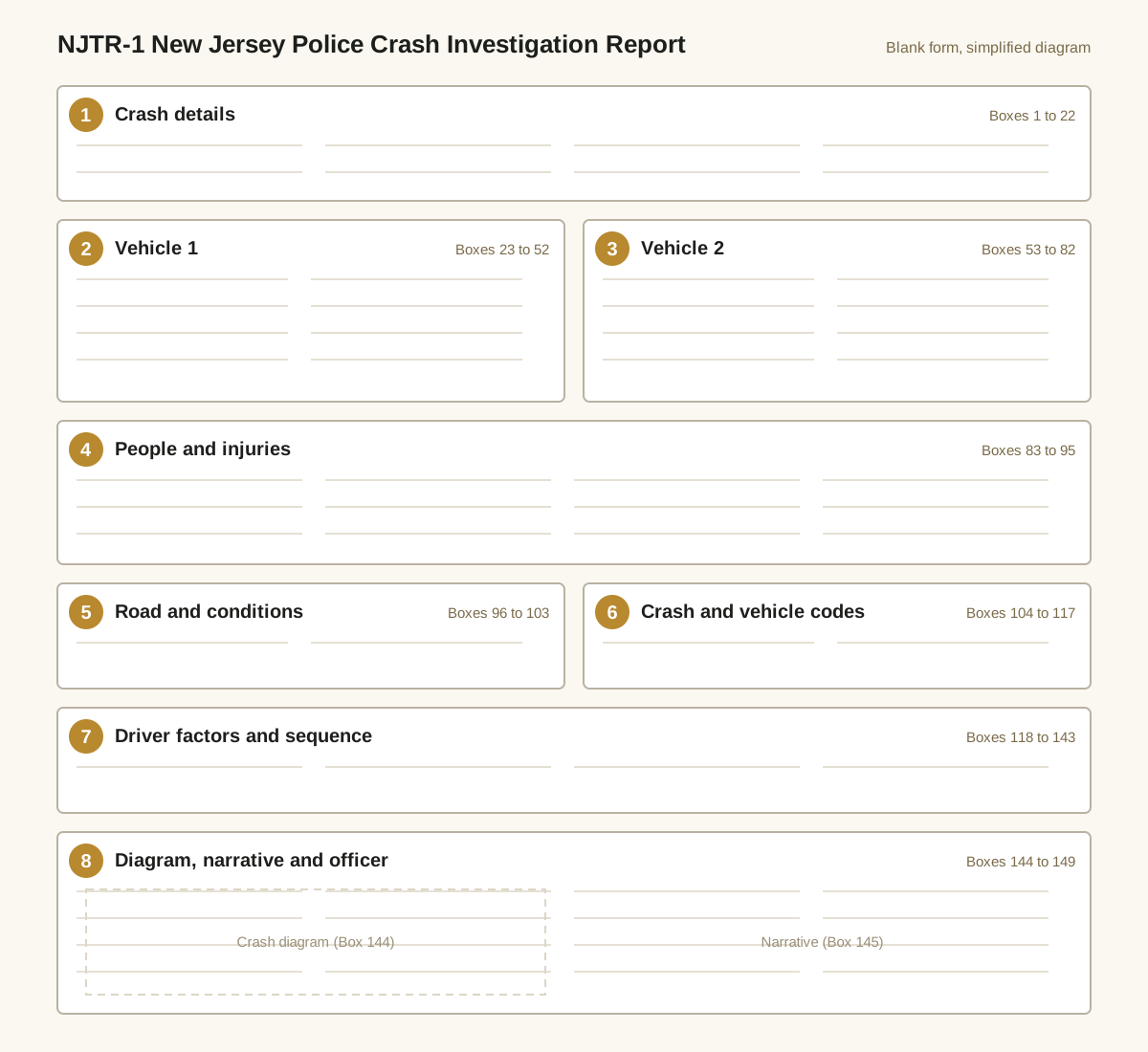
- Crash details (Boxes 1 to 22): case number, agency, date, time, town and exact location.
- Vehicle 1 (Boxes 23 to 52): driver, owner, plate, policy number, insurance code, VIN, towing and commercial vehicle details.
- Vehicle 2 (Boxes 53 to 82): the same fields for the second vehicle.
- People and injuries (Boxes 83 to 95): one row for each person, with seat, injury severity, injury type, safety equipment and hospital.
- Road and conditions (Boxes 96 to 103): road type, light, surface, weather and work zone.
- Crash and vehicle codes (Boxes 104 to 117): crash type, number of vehicles, vehicle type and use.
- Driver factors, sequence, damage and summonses (Boxes 118 to 143): contributing circumstances, driver condition, pre-crash action, traffic controls, sequence of events, impact points, damage and tickets.
- Diagram, narrative and officer (Boxes 144 to 149): the sketch, the written description, and the officer and supervisor details.
Sample annotated NJTR-1 crash report
The official NJTR-1 form, page by page
These are the actual pages of the State of New Jersey Police Crash Investigation Report, reproduced from the New Jersey Department of Transportation's official NJTR-1 Crash Report Manual (Edition 2.0, effective January 1, 2023). The manual shades each part of the form and labels it Section 1 to Section 7, which makes it easy to match the blank form to the copy you were given. Tap any page to enlarge it.
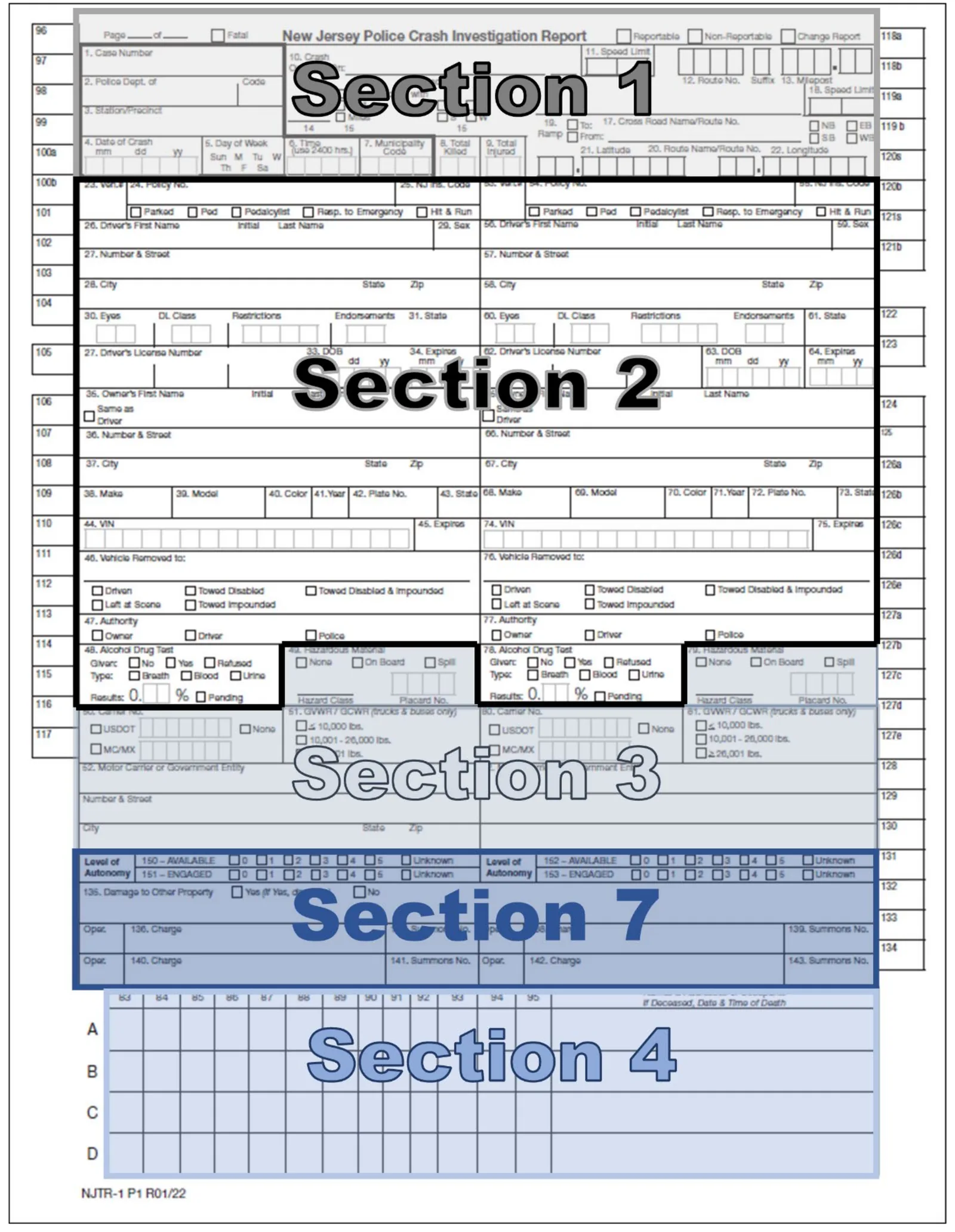
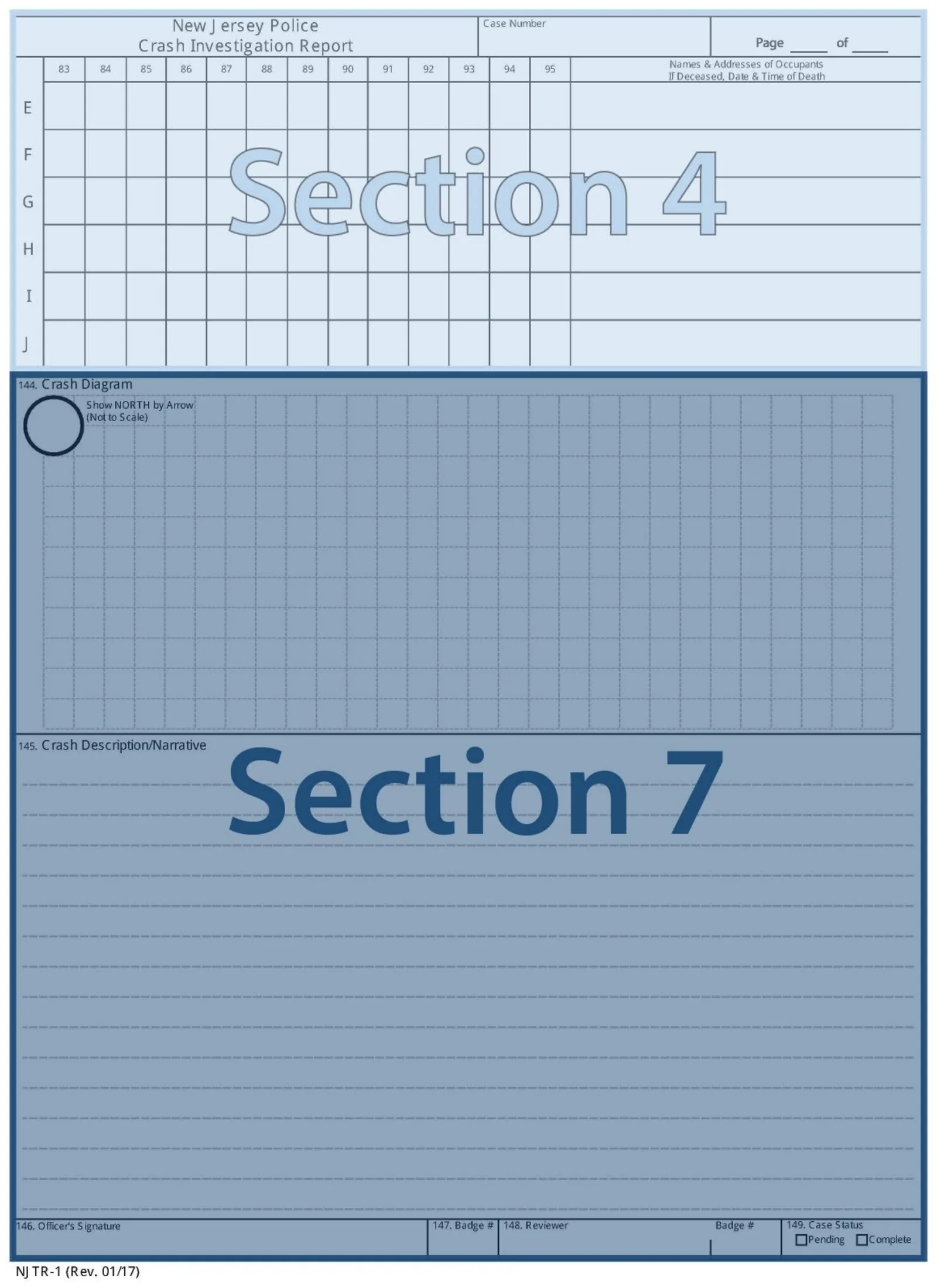
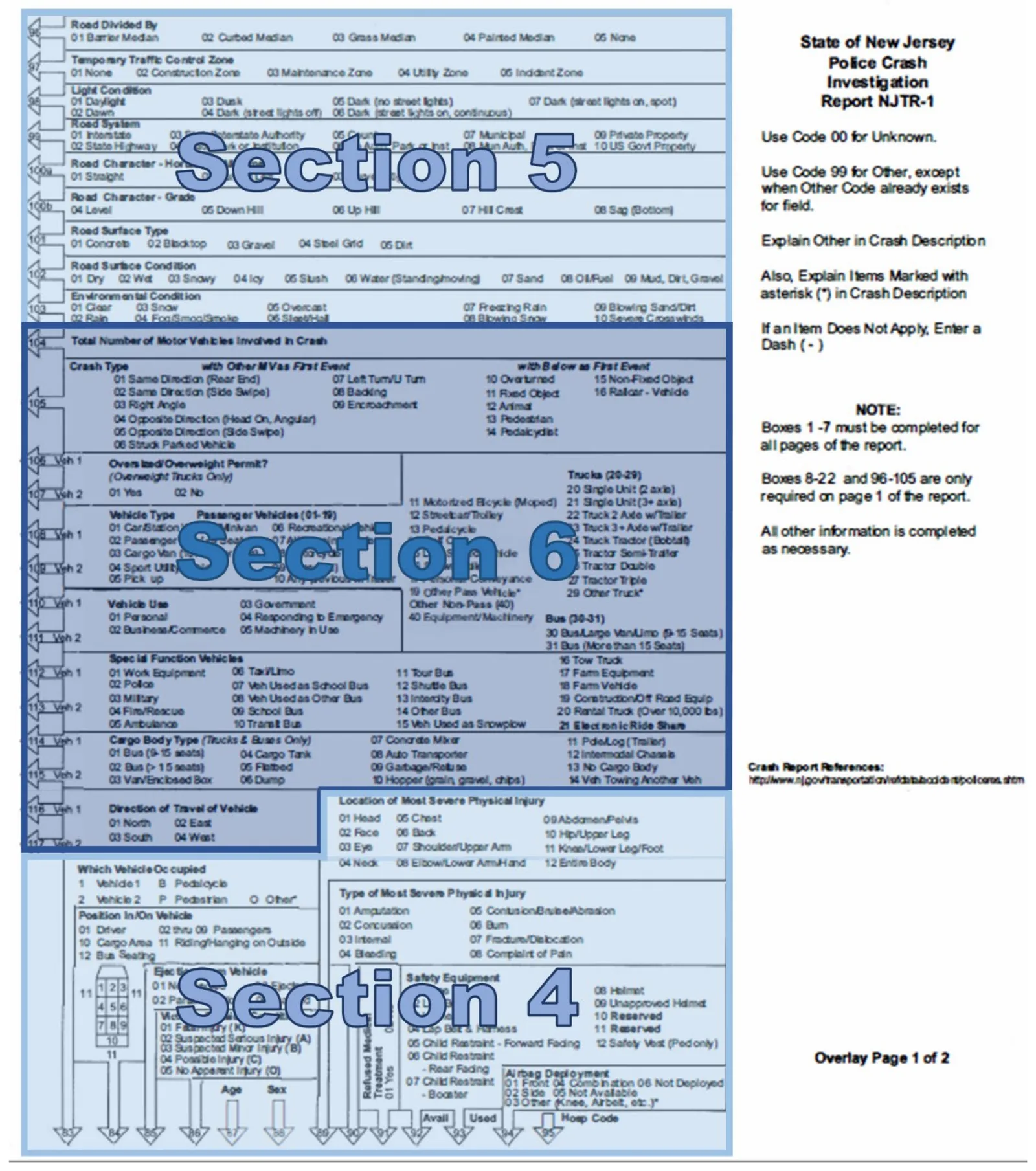
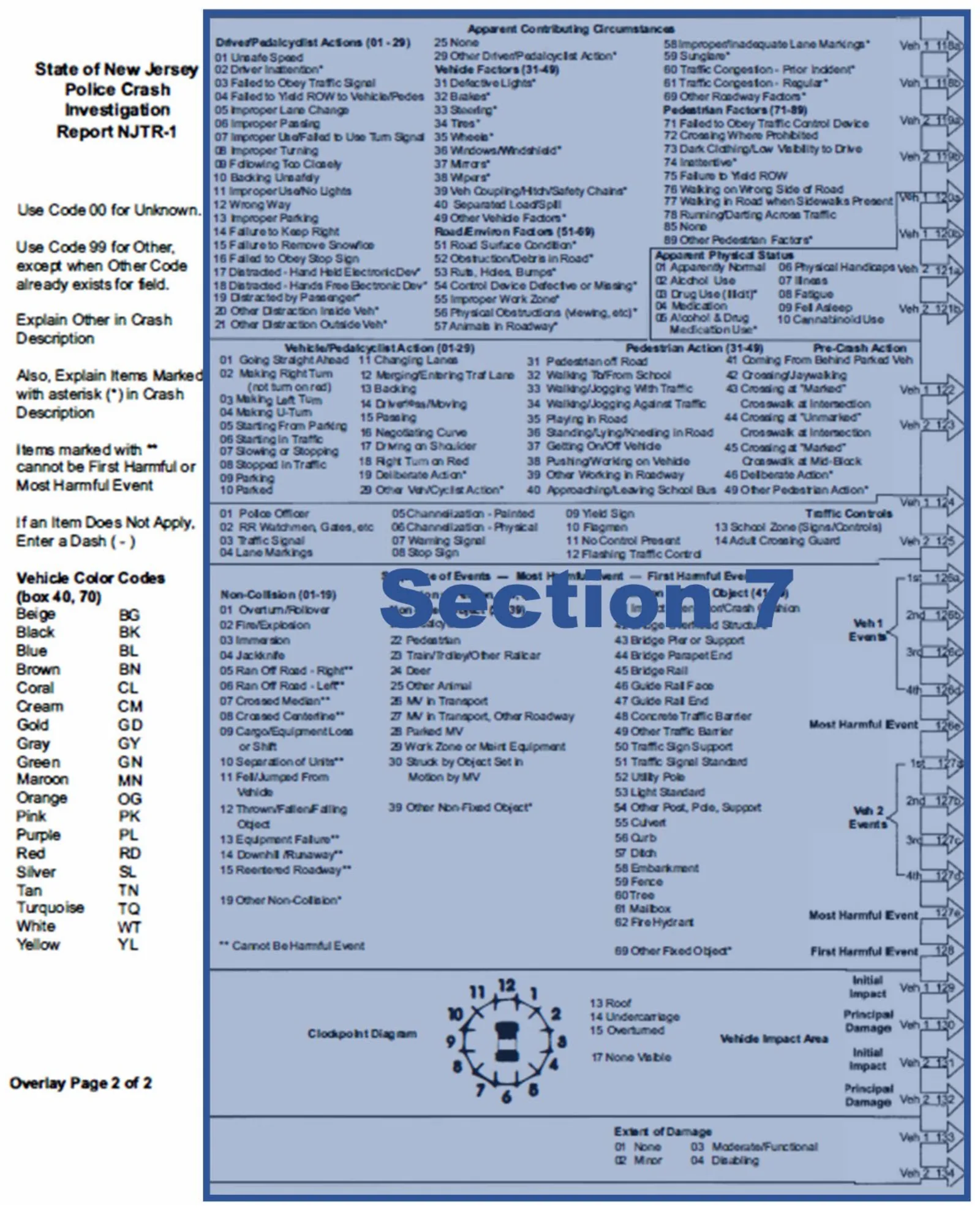
Form pages reproduced from the NJTR-1 Crash Report Manual, New Jersey Department of Transportation, 2023. The "Section" shading appears in the manual only, not on the report you receive.
Your copy will not show the overlay pages. The overlays are the code key the officer works from, which is why your report is mostly two-digit numbers. Use the tables in this guide, or the overlay pages above, to turn those numbers back into words.
Extra pages that may come with your report
Ask for every page. A serious crash often comes with supplemental forms that are part of the same report:
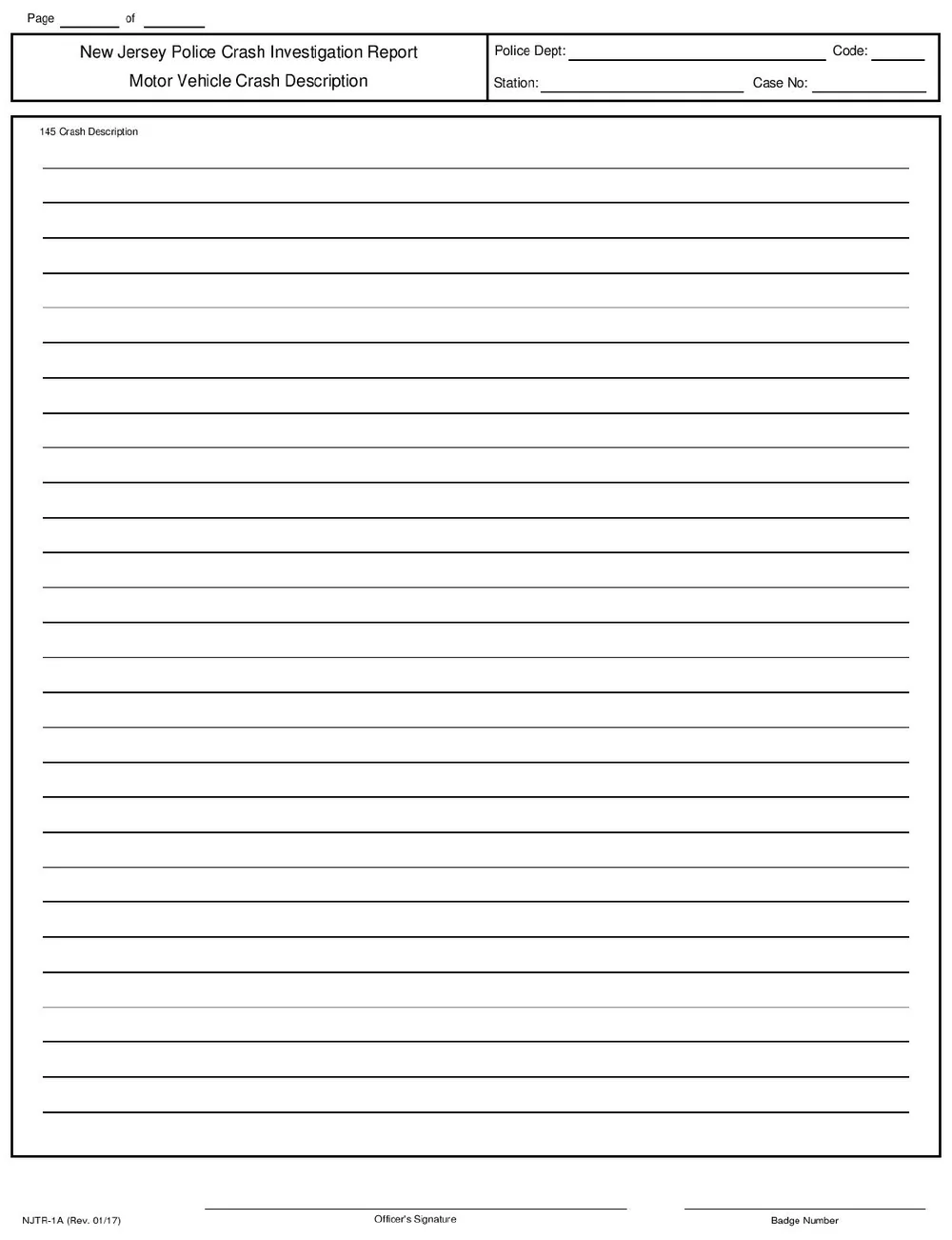
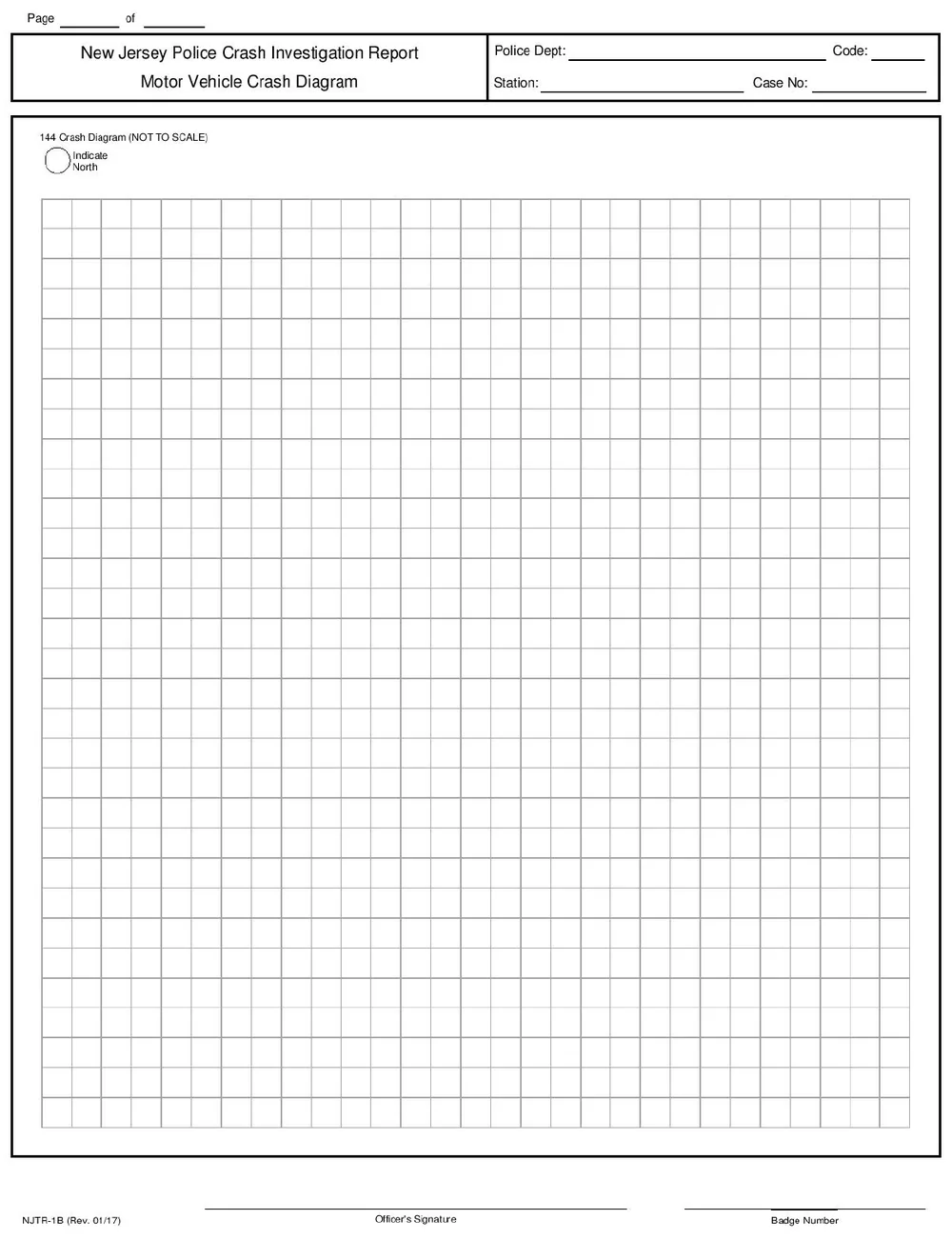
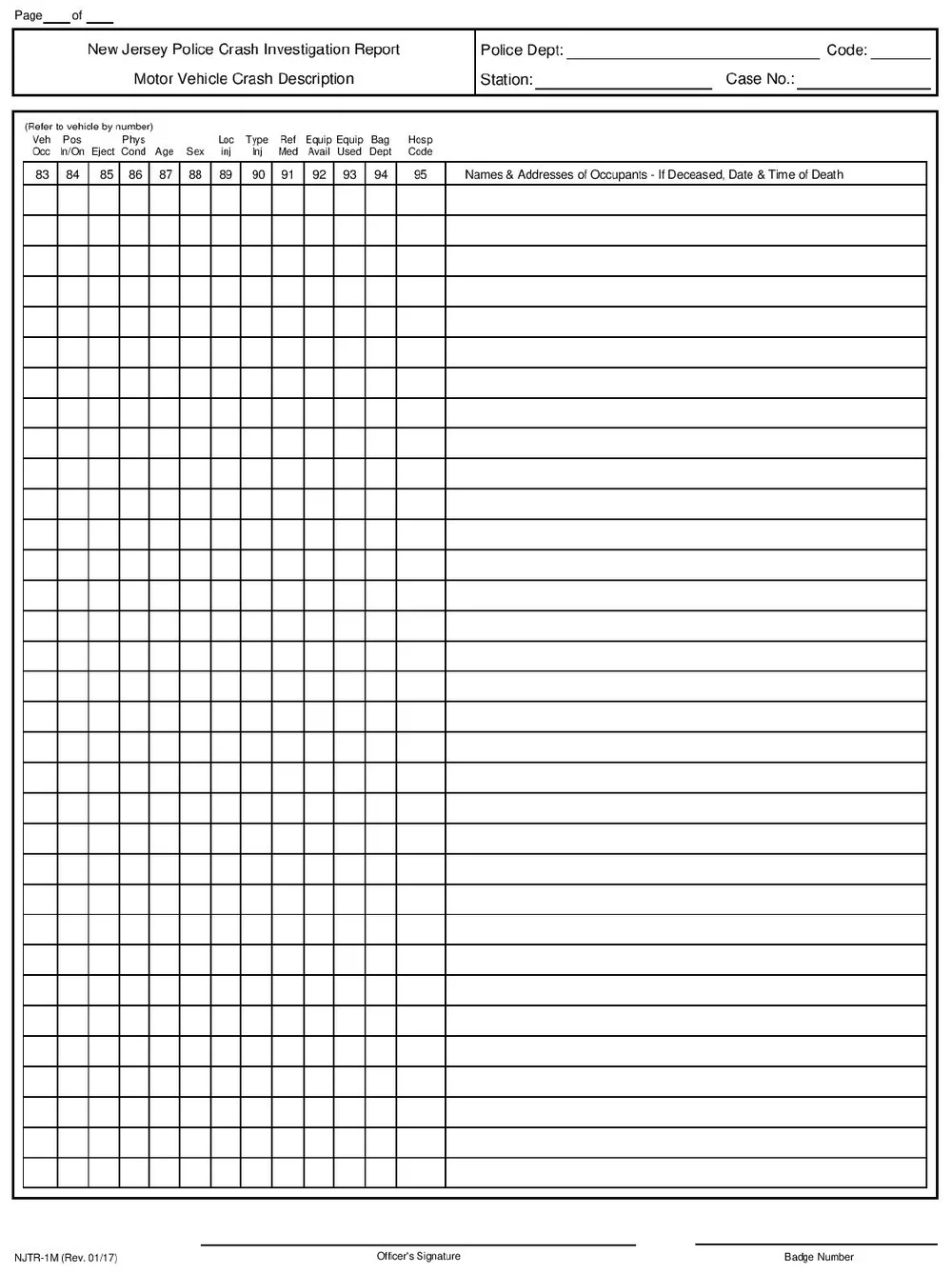
A crash with three or more vehicles, pedestrians or cyclists gets an additional NJTR-1 page for the extra parties. Extra summonses do not get a new page; the manual tells officers to list them in the Box 145 narrative instead. If your copy is missing pages, the report may look incomplete when it is not.
When police must write a report (and when you file one yourself)
The manual's opening chapter lays out the rules that decide whether there will be a police report at all:
- Reportable crashes. A driver involved in a crash that injures or kills anyone, or causes more than $500 in damage to any one person's property, must notify the police by the quickest means available (N.J.S.A. 39:4-130). A crash with no injuries and $500 or less in damage is "non-reportable," and departments may record it differently.
- Five-day filing. The investigating officer must forward the written report to NJDOT within five days of the investigation (N.J.S.A. 39:4-131). The report is a public record you can inspect and buy.
- Parking lots and private property count. Crashes in parking lots, on private streets and on other private property are reported the same way as crashes on public roads.
- No officer came to the scene. Police are told not to write an NJTR-1 for a crash they did not investigate. Instead, the person reporting it uses the state's online SR-1 self-reporting form (search "NJSR1"). If no officer files a report, the driver must send the SR-1 to the Motor Vehicle Commission within 10 days (N.J.S.A. 39:4-130).
- Hit-and-run without a police investigation. If you have the other car's plate, the manual points to the Motor Vehicle Commission's records request form (DO-11A) to get owner and insurance information.
- Change reports. When new facts come in, such as a hit-and-run driver being identified or an injured person later dying, the department files a new report with the "Change Report" box checked. The case number in Box 1 must match the original exactly.
- Fatal crashes. Local police must notify the State Police Fatal Accident Investigation Unit within 24 hours and send the NJTR-1 within 72 hours, even if it is not complete. The detailed criminal investigation file is usually released later.
Why it matters: if your crash happened in a store parking lot, it should still have a police report. If you were hurt in a crash the police never investigated, file the SR-1 promptly and see a doctor, because insurers look for gaps between the crash and the first record of it.
How to get your crash report, step by step

- Find out which agency wrote the report. Look at the card or paperwork the officer gave you. Local police handle most town and county roads; the New Jersey State Police handle most interstates and state highways, plus the Turnpike and Garden State Parkway.
- Gather your crash details. Have the case number (Box 1), the date and the location ready. The State Police portal can also search by driver's license number, plate number or last name.
- Request the report. For State Police, Turnpike and Parkway crashes, order online at njportal.com/njsp/crashreports. For local police, use that department's records bureau or online request link.
- Check the top of the report. Confirm the case number, date, time and exact location in Boxes 1 to 22. The location affects which county court hears a case.
- Check each vehicle column. Confirm each driver's name, plate, policy number and the three-digit NJ insurance code in Box 25 (Vehicle 1) and Box 55 (Vehicle 2).
- Read the injury codes. Find your row in Boxes 83 to 95. Box 86 is the officer's view of injury severity, and Boxes 89 and 90 are the location and type of the most severe injury.
- Read the contributing circumstances. Boxes 118 and 119 list up to two codes per driver for what the officer believes contributed to the crash, such as 09 Following Too Closely.
- Read the diagram and narrative. Compare the diagram and Box 145 narrative with what happened. Ask the department in writing to correct factual mistakes quickly.
What you need before you ask
- The case number (Box 1). It is usually on the card or slip the officer handed you.
- The date and location of the crash, including the town and the road.
- A driver's name, license number or plate number, which some systems use to search.
- Photo ID if you pick the report up in person.
From a local police department
- Find the department that responded. If you are not sure, call the non-emergency number of the town where the crash happened.
- Check the department's website for a "records" or "crash reports" page. Many towns sell reports through an outside online vendor, such as LexisNexis BuyCrash or CrashDocs, linked from the police website. Use only the vendor your department links to, because look-alike sites charge extra for the same public record.
- If there is no online option, request it from the records bureau in person or by mail with the case number, date and location.
- Pay the copy fee. If you pick the report up in person, the town may charge only the standard public-records copy rate. If it is mailed or sent other than in person, state law allows up to $5 for the first three pages and $1 for each page after that (N.J.S.A. 39:4-131). Online vendors usually add their own convenience fee.
- If the report is not ready, ask when the supervisor is expected to approve it, and call back.
From the New Jersey State Police
- Confirm the State Police wrote the report. Most crashes on interstates, state highways, the Turnpike and the Garden State Parkway are State Police reports.
- Go to the State Police and Turnpike Authority crash report portal at njportal.com/njsp/crashreports. It covers State Police reports, Turnpike and Garden State Parkway reports, and boat crash reports. It does not cover the Atlantic City Expressway.
- Search by case number, license plate number or driver's license number.
- Pay the fee: $13 for a non-toll road report and $5 for a Turnpike or Parkway report. The portal takes major credit and debit cards.
- Watch for an email with download instructions once the report is ready. Reports stay on the portal for six years after the year of the crash; for an older crash, email njsprecords@njsp.gov.
How long it takes
A report cannot be released until the officer finishes it and a supervisor approves it. The State Police portal says a report can take up to 14 business days from the crash date to become searchable. If you still cannot find it after 15 business days, the State Police ask you to email njsprecords@njsp.gov. Local departments vary: some reports are ready in a few days, others take a few weeks. A crash with a death or a criminal charge can take longer, because parts of the file may be held while the investigation continues.
Which agency has your report
| Where the crash happened | Agency that writes the report | How to request it |
|---|---|---|
| Local streets and most county roads in a town | That town's police department | Records bureau, in person or by mail, or the department's online request link. Many towns sell reports through an online vendor linked from the police website. |
| Interstates and state highways patrolled by the State Police, and towns without their own police | New Jersey State Police | Online at njportal.com/njsp/crashreports, $13 per report |
| New Jersey Turnpike and Garden State Parkway | New Jersey State Police | Same portal, $5 per toll road report. Fatal Turnpike and Parkway crash reports require an OPRA request to the Turnpike Authority. |
| Atlantic City Expressway | Investigating agency (not on the state portal) | Written request to the Atlantic City Expressway Authority, P.O. Box 389, Hammonton, NJ 08037, (609) 965-7200 ext. 108 |
| Port Authority bridges, tunnels and airports | Port Authority Police | Request from the Port Authority Police Department |
| County parks and county police areas | County police or sheriff | Request from that county agency |
How to request a report by town
There is no single statewide lookup for local police reports. In nearly every town, the report comes from the department that responded. Here is where to start in the towns we hear from most:
| Town | Where to request |
|---|---|
| Newark, Jersey City, Paterson, Elizabeth, Hoboken, Bayonne | City police department records bureau. These departments write most crash reports inside city limits; crashes on I-78, I-280 and the Turnpike are usually State Police reports. |
| Parsippany-Troy Hills, Morristown, Hackensack, Fort Lee, Wayne, Clifton | Township or city police department. Crashes on I-80, I-287 and Route 4 or 17 may be handled by the State Police or the local department, depending on location. |
| Toms River, Edison, Woodbridge, New Brunswick, Cherry Hill, Trenton | Township or city police department. Garden State Parkway and Turnpike crashes in these towns are State Police reports on the state portal. |
| Small towns without a local police department | New Jersey State Police station that covers the town, ordered through the state portal |
Fees and request methods change, so check the department's website or call its records bureau before you go. Have the case number, date, location and the names of the drivers ready. For a crash with serious injuries or a death, photographs, video and statements are not part of the basic report and usually require a subpoena or court order.
NJTR-1 box map: what each box means
| Box | What it records |
|---|---|
| 1 | Case number. Quote it when you request the report. |
| 2 | Police department type (01 Municipal, 02 State Police, 03 County, 04 Port Authority, 05 County Sheriff, 99 Other) |
| 4, 5, 6 | Date, day of week and time of the crash |
| 7 | Municipality code (the town where the crash happened) |
| 8, 9 | Total killed and total injured |
| 10 to 22 | Crash location: road, cross street, route, mile marker and latitude and longitude |
| 23 to 48 | Vehicle 1: driver, owner, vehicle, policy number, insurance code, VIN, towing |
| 24 / 54 | Insurance policy number for Vehicle 1 / Vehicle 2 |
| 25 / 55 | Three-digit NJ insurance company code for Vehicle 1 / Vehicle 2 |
| 48 / 78 | Alcohol or drug test information |
| 49 to 52, 79 to 82 | Commercial vehicle and hazardous material details |
| 53 to 78 | Vehicle 2: same fields as Vehicle 1 |
| 83 to 95 | Every person involved: seat, ejection, injury severity, age, sex, injury location and type, safety equipment, airbags, hospital |
| 96 to 103 | Road system: median, work zone, light, road type, alignment, surface, surface condition, weather |
| 104 | Total number of motor vehicles involved |
| 105 | Crash type (rear end, right angle, head on, pedestrian and so on) |
| 106, 107 | Oversized or overweight permit (overweight trucks only) |
| 108, 109 | Vehicle type for Vehicle 1 / Vehicle 2 |
| 110, 111 | Vehicle use: personal, business, government, emergency or machinery |
| 112, 113 | Special function, such as police, ambulance, taxi, school bus, tow truck or 21 Electronic Ride Share |
| 114, 115 | Cargo body type (trucks and buses only) |
| 116, 117 | Direction of travel |
| 118, 119 | Apparent contributing circumstances for each driver (up to two codes each) |
| 120, 121 | Apparent physical status of each driver (up to two codes each) |
| 122, 123 | Pre-crash action of each vehicle, cyclist or pedestrian |
| 124, 125 | Traffic controls |
| 126, 127 | Sequence of events for each vehicle (up to four events) and its most harmful event |
| 128 | First harmful event for the whole crash |
| 129 to 132 | Initial point of impact and area of principal damage on each vehicle (clock codes) |
| 133, 134 | Extent of damage to each vehicle |
| 135 | Damage to other property, such as fences, lawns or hydrants, with the owner's name |
| 136 to 143 | Summonses: which driver was charged and the statute, most serious charge first |
| 144 | Crash diagram (required on every report) |
| 145 | Crash description, the officer's written narrative |
| 146 to 149 | Officer signature, badge number, supervisor review and case status (pending or complete) |
| 150 to 153 | Level of driving automation available and engaged in each vehicle (added in 2023) |
Vehicle 1 uses Boxes 23 to 48 and Vehicle 2 uses the matching Boxes 53 to 78. Being listed as Vehicle 1 is not a finding of fault.
The 7 sections of the NJTR-1, explained
The official manual divides the form into seven sections. Read the report in this order. Each section answers a different question an insurer or lawyer will ask.
1. Crash location (Boxes 1 to 22)
The top of the report identifies the crash. Box 1 is the case number, which you will quote every time you request the report or talk to an insurer. Box 2 is the type of police agency (municipal, State Police, county, Port Authority, sheriff or other). Boxes 4 to 6 give the date, day of the week and time, and Box 7 is the four-digit municipality code for the town where the crash happened. Boxes 8 and 9 count the people killed and injured. Boxes 10 to 22 pin down the location: the road, the nearest cross street, route numbers, mile markers and, on newer reports, latitude and longitude.
The manual sets two rules worth knowing. The town is the place where the first harmful event happened, and if a car left the road in one town and hit something in the next, the town where it left the road is used. For crashes outside an intersection, the officer measures from the center of the intersection to the point of impact.
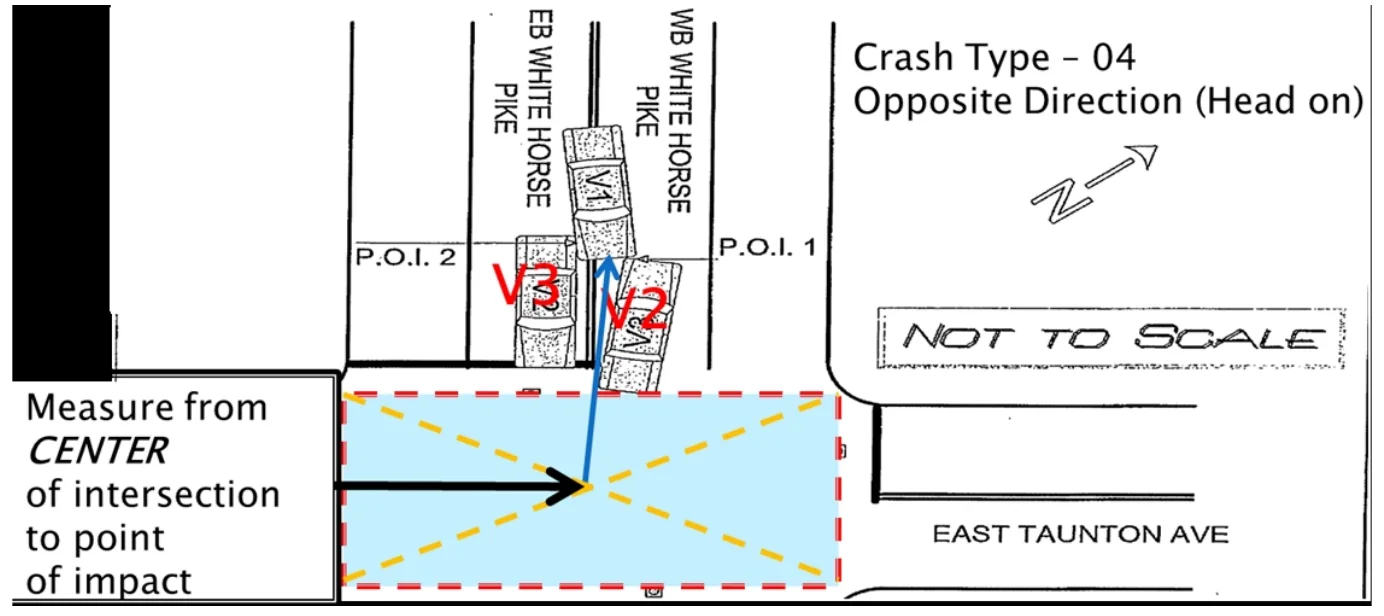
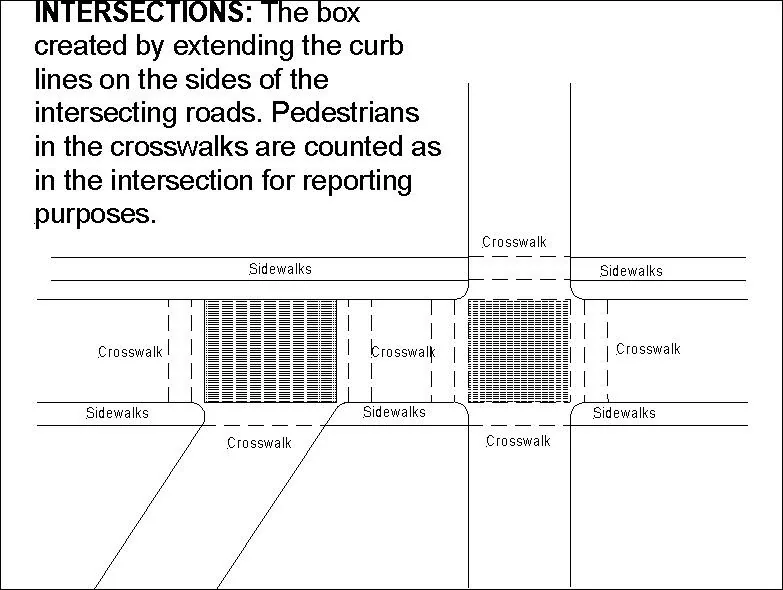
Why it matters: the location decides which agency has the records, which town or county may be responsible for a road defect, and which county court can hear a lawsuit. A wrong date or time can also make it harder to find surveillance video or match the crash to 911 records. Check that the cross street and direction are right, because a crash "near" an intersection can be placed on the wrong side of it. If the town code is wrong, the report can also be misfiled, which is one reason a report may not turn up when you search for it.
2. Drivers, vehicles and insurance (Boxes 23 to 48 and 53 to 78)
Each vehicle gets its own block: Boxes 23 to 48 for Vehicle 1 and Boxes 53 to 78 for Vehicle 2. These boxes list the driver's name, address, date of birth and license, the owner if different, the plate and registration, the vehicle year, make, model and color, the VIN, and whether it was towed and who authorized the removal. Box 24 and Box 54 hold the insurance policy numbers, and Box 25 and Box 55 hold the three-digit New Jersey insurance company codes. Boxes 48 and 78 note alcohol or drug testing. Pedestrians and cyclists are listed in this section too, by name and address, without a license number.
Why it matters: this is how you find out who to claim against. The owner and the driver can be different people, and both can matter, for example when an employee drives a company van or a family member borrows a car. Being Vehicle 1 or Vehicle 2 is only the order the officer listed the cars; it is not a finding of fault. Compare every name, plate and policy number with the insurance card you photographed at the scene, because a single wrong digit can delay a claim for weeks. If a blood or urine test was taken, the results come later and the department is supposed to file a change report when they arrive.
3. Commercial vehicle (Boxes 49 to 52 and 79 to 82)
These boxes are filled in only for a commercial motor vehicle and are left blank for ordinary cars. Under the manual, a vehicle is commercial if it has a gross weight rating of 10,001 pounds or more, carries placarded hazardous material, carries 16 or more people including the driver, or requires a commercial driver's license (a livery or limo, for example).
- Box 49 / 79, Hazardous material: none, on board or spilled, with the hazard class and the four-digit placard number.
- Box 50 / 80, Carrier number: the USDOT number (and MC/MX number) of the motor carrier responsible for the cargo.
- Box 51 / 81, Weight: 10,000 lbs. or less, 10,001 to 26,000 lbs., or 26,001 lbs. or more.
- Box 52 / 82, Motor carrier or government entity: the carrier's name and address.
Why it matters: in a truck crash, the carrier in Box 50 is often the company with the insurance that matters, and it is not always the name painted on the door. The manual itself warns officers that the carrier and the owner can be different companies, and that the USDOT number on the truck may not belong to the carrier responsible for the load. The USDOT number lets a lawyer pull the carrier's federal safety record, and interstate carriers must carry federal minimum liability coverage under 49 C.F.R. Part 387 that is far higher than New Jersey's minimums for cars. Learn more about New Jersey truck accident claims.
4. Persons involved (Boxes 83 to 95)
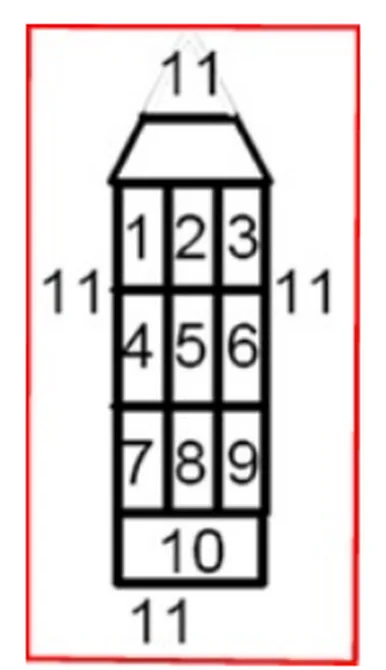
Every person involved gets one row, lettered A, B, C and so on, including drivers, passengers, pedestrians and cyclists. The row shows which vehicle the person was in (or P for pedestrian, B for pedalcycle), where they were sitting, whether they were ejected or trapped, their age and sex, the officer's view of injury severity in Box 86, the body area of the most severe injury in Box 89, the type of injury in Box 90, whether the person refused treatment in Box 91, safety equipment in Boxes 92 and 93, airbag deployment in Box 94 and the hospital code in Box 95. For a death, the name, address, date and time of death go next to Box 95.
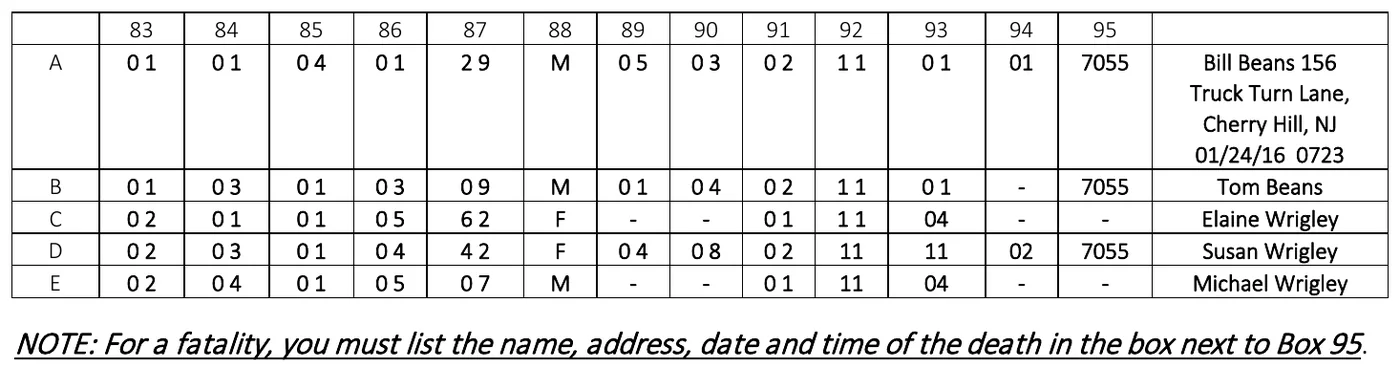
Source: NJDOT, NJTR-1 Crash Report Manual, Edition 2.0 (2023).
Why it matters: adjusters read the injury codes first, and they often use a "possible injury" or "no apparent injury" code to argue you were not really hurt. The officer is not a doctor and records only what can be seen at the scene. Herniated discs, concussions and soft tissue injuries often show up later. Seat belt and airbag codes also come up, because an insurer may argue an injury would have been less serious with a belt. The table below shows the official Box 86 codes and what each one tends to mean for a claim. Click a column heading to sort it.
| 01 | Fatal Injury (K) | The family may have a wrongful death and survival claim. The report helps fix the time, place and cause of death. |
| 02 | Suspected Serious Injury (A) | Shows the injury was obvious at the scene. Helpful, but the verbal threshold is still proven with medical records, not this code. |
| 03 | Suspected Minor Injury (B): an evident injury other than fatal or serious | Records a visible injury. Insurers may call it minor; your diagnosis and treatment count for more than the scene code. |
| 04 | Possible Injury (C): a reported or claimed injury that is not fatal, serious or minor | Common for neck, back and head complaints. Adjusters may argue you were barely hurt, so get prompt care that documents the injury. |
| 05 | No Apparent Injury (O) | Does not mean you were not hurt. Many injuries appear later. See a doctor and keep records that tie the injury to the crash. |
5. Roadway system (Boxes 96 to 103)
Boxes 96 to 103 describe the road and the conditions: whether there was a median, whether it was a construction, maintenance, utility or incident zone, the light, the road system (interstate, state, county, municipal, private property and so on), the curve and grade, the surface type, the surface condition and the weather. The full codes are in the road, light and weather table below.
Why it matters: road condition codes matter for speed, because drivers must slow down for wet, icy or dark roads. Box 99 tells you who owns the road, which is the first step in any claim against a town, county or the State for a pothole, missing sign or bad work zone setup. Those public-entity claims need a written notice within 90 days, so these codes are worth reading early. A "Dark (no street lights)" code in a pedestrian crash, or an incident zone code in a secondary crash, can also change how fault is argued.
6. Crash and vehicle characteristics (Boxes 104 to 117)
These boxes describe the crash itself and the vehicles: how many vehicles were involved (Box 104), the crash type (Box 105), whether an overweight truck had a permit, each vehicle's type and use, any special function such as police, ambulance, school bus, tow truck or ride share, the cargo body on trucks and buses, and each vehicle's direction of travel.
Why it matters: the crash type is a quick summary of how the vehicles met, and insurers use it to sort claims. A rear-end code usually points to the following driver, while a right-angle code sends everyone to the traffic signal and right-of-way questions. Vehicle use and special function codes can flag a work vehicle, a government vehicle or a rideshare car. Code 21 Electronic Ride Share in Box 112 or 113 is especially useful: it shows the officer saw the car as an Uber or Lyft, which can bring in the company's commercial coverage. See our guide to Uber and Lyft accident claims in New Jersey.
7. Contributing circumstances, sequence of events, damage, diagram and narrative (Boxes 118 to 153)
This is the part adjusters read most closely. In Boxes 118 and 119 the officer picks up to two "apparent contributing circumstances" for each driver, chosen from human, vehicle, road and pedestrian codes. The manual tells officers to pick the most prominent factors even when no summons is issued, and codes marked with an asterisk (*) must be explained in the narrative. Boxes 120 and 121 record each driver's apparent physical status, Boxes 122 and 123 show what each vehicle or pedestrian was doing just before the crash, Boxes 124 and 125 record traffic controls, and Boxes 126 to 128 lay out the sequence of events.
Why it matters: a code like 09 Following Too Closely or 17 Distracted, Hand Held Electronic Device can shape the whole claim, and a wrong code can follow you for months. These are opinions, not findings, and they can be challenged with video, photos, witnesses and vehicle data. Road codes such as 53 Ruts, Holes, Bumps or 54 Traffic Control Device Defective can also point to a public-entity claim. The table below lists every official contributing circumstance code with a short note on why it matters. Click a column heading to sort it.
| 01 | Unsafe Speed | Supports a speeding or too-fast-for-conditions argument against that driver. |
| 02 | Driver Inattention* | Inattention is a common basis for negligence. Must be explained in the narrative. |
| 03 | Failed to Obey Traffic Signal | Strong fault evidence in intersection crashes; check signal timing and video. |
| 04 | Failed to Yield Right of Way to Vehicle / Pedestrian | Often the key code in turning and intersection crashes. |
| 05 | Improper Lane Change | Points to the lane-changing driver; dashcam video can confirm it. |
| 06 | Improper Passing | Supports fault against the passing driver. |
| 07 | Improper Use / Failed to Use Turn Signal | Missing turn signals help explain a sudden turn or lane change. |
| 08 | Improper Turning | Supports fault for wide, short or illegal turns. |
| 09 | Following Too Closely | The usual code in rear-end crashes; insurers rarely dispute it. |
| 10 | Backing Unsafely | Common in parking lot and driveway crashes. |
| 11 | Improper Use / No Lights | Matters in night crashes; ties to N.J.S.A. 39:3-46 lighting rules. |
| 12 | Wrong Way | Wrong-way driving is strong evidence of fault. |
| 13 | Improper Parking | Can make a parked or stopped vehicle partly responsible. |
| 14 | Failure to Keep Right | Supports fault in head-on and sideswipe crashes. |
| 15 | Failure to Remove Snow / Ice | New Jersey requires drivers to clear snow and ice from their vehicles (N.J.S.A. 39:4-77.1). |
| 16 | Failure to Obey Stop Sign | Strong fault evidence in intersection crashes. |
| 17 | Distracted, Hand Held Electronic Device* | Phone use while driving can support a stronger claim. Phone records may be requested. |
| 18 | Distracted, Hands Free Electronic Device* | Even hands-free use can show distraction. Must be explained in the narrative. |
| 19 | Distracted by Passenger* | Shows the driver was not focused on the road. |
| 20 | Other Distraction Inside Vehicle* | Eating, adjusting controls and similar distractions support negligence. |
| 21 | Other Distraction Outside Vehicle* | Outside distractions still count against the driver who looked away. |
| 25 | None | The officer saw no driver error for that driver. Not proof that the driver did nothing wrong. |
| 29 | Other Driver / Pedalcyclist Action* | A catch-all; read the narrative for what the officer meant. |
| 31 | Defective Lights | Can point to a maintenance problem for the owner. |
| 32 | Brakes* | Possible brake defect or poor maintenance; preserve the vehicle. |
| 33 | Steering* | Possible steering defect; preserve the vehicle before repairs. |
| 34 | Tire* | Tire failure can point to the owner, a shop or a manufacturer. |
| 35 | Wheels* | Wheel failure can point to recent repair work or a defect. |
| 36 | Windows / Windshield* | Blocked or damaged glass can limit what the driver could see. |
| 37 | Mirrors | Missing mirrors matter in lane-change and backing crashes. |
| 38 | Wipers | Bad wipers matter in rain and snow crashes. |
| 39 | Vehicle Coupling / Hitch / Safety Chains* | Trailer and hitch failures can involve the owner, a renter or a shop. |
| 49 | Other Vehicle Factor* | A catch-all; the narrative should name the vehicle problem. |
| 51 | Road Surface Condition* | Wet, icy or oily roads can matter for speed and for public-entity claims. |
| 52 | Obstruction / Debris on Road* | Debris may point to whoever dropped it or should have removed it. |
| 53 | Ruts, Holes, Bumps* | Potholes can support a claim against a town, county or the State (90-day notice). |
| 54 | Traffic Control Device Defective / Missing* | A broken or missing signal or sign can support a public-entity claim (90-day notice). |
| 55 | Improper Work Zone* | Work zone setup can point to a contractor or a public entity. |
| 56 | Physical Obstruction(s) (viewing, etc.)* | Blocked sight lines can involve a property owner or a public entity. |
| 57 | Animal(s) in Roadway* | Animal crashes usually turn on your own insurance coverage. |
| 58 | Improper / Inadequate Lane Markings* | Faded or confusing markings can support a public-entity claim (90-day notice). |
| 59 | Sun Glare* | Sun glare does not excuse careless driving, but insurers raise it. |
| 60 | Traffic Congestion, Prior Incident* | Secondary crashes in backups often involve following too closely. |
| 61 | Traffic Congestion, Regular* | Regular congestion is not an excuse for a rear-end crash. |
| 69 | Other Roadway Factors* | A catch-all; the narrative should explain the road problem. |
| 71 | Failed to Obey Traffic Control Device | Insurers use this against pedestrians; New Jersey's comparative negligence rule still allows recovery up to 50% fault. |
| 72 | Crossing Where Prohibited | Can reduce, but often does not bar, a pedestrian's recovery. |
| 73 | Dark Clothing / Low Visibility to Driver | Insurers raise visibility; drivers must still watch for pedestrians. |
| 74 | Inattentive* | An opinion code that can be challenged with video and witnesses. |
| 75 | Failure to Yield Right of Way | Drivers must still stop for pedestrians in crosswalks (N.J.S.A. 39:4-36). |
| 76 | Walking on Wrong Side of Road | Can be raised as comparative fault. |
| 77 | Walking in Road When Sidewalk Is Present | Can be raised as comparative fault. |
| 78 | Running / Darting Across Traffic | Insurers use this to argue the driver could not stop. |
| 85 | None | The officer saw no pedestrian error, which helps the pedestrian's claim. |
| 89 | Other Pedestrian Factors* | A catch-all; read the narrative. |
The rest of Section 7 covers what happened to the vehicles and who was charged. Boxes 129 to 132 mark the initial point of impact and the area of principal damage on each vehicle using a clock face, Boxes 133 and 134 rate the extent of damage, and Box 135 lists damage to other property. Boxes 136 to 143 list summonses, with the most serious charge first, such as N.J.S.A. 39:4-89 for following too closely. Box 144 is the diagram, which the manual requires on every report, Box 145 is the narrative, Boxes 146 to 149 identify the officer, badge number, supervisor and case status, and Boxes 150 to 153 (added in 2023) record driver-assist and self-driving technology.
The manual tells officers what the Box 145 narrative must include at a minimum: the physical facts of the crash, a summary of what every driver, pedestrian and witness said, and the officer's own objective conclusions. It should also explain every asterisk code, describe the clothing of any pedestrian or cyclist, note any photos taken or evidence collected, and list the name, address and phone number of each witness. In the diagram, the officer marks north, numbers each vehicle, and shows lanes, markings, traffic controls and view obstructions. If the vehicles were moved before the officer arrived, the diagram is a "representative" drawing and the narrative should say so.
Why it matters: adjusters often read the narrative before anything else, because it tells the story in plain words. If your statement was written down wrong, or the diagram puts a car in the wrong lane, that is the most important thing to fix. Witness contact details in the narrative are often the fastest way to find an independent witness. A ticket helps show the other driver was careless, but it is not the final word: negligence is decided separately in the injury case. The officer's name and badge number tell you who to contact for corrections, and Box 149 tells you whether the report is pending or complete. If it is still pending, ask when a final version will be ready before relying on it.
Injury codes (Boxes 83 to 95)
Each person involved gets one row. The officer records injuries as seen at the scene, not from a doctor's diagnosis or hospital records. A "Possible Injury" or "No Apparent Injury" code does not mean you were not hurt. Herniated discs and concussions often show up hours or days later; your medical records tell the real story.
Box 86: Victim's physical condition (injury severity)
| Code | Meaning |
|---|---|
| 01 | Fatal Injury (K) |
| 02 | Suspected Serious Injury (A) |
| 03 | Suspected Minor Injury (B): an evident injury other than fatal or serious |
| 04 | Possible Injury (C): a reported or claimed injury that is not fatal, serious or minor |
| 05 | No Apparent Injury (O) |
Box 89: Location of most severe physical injury
| Code | Body area |
|---|---|
| 01 | Head |
| 02 | Face |
| 03 | Eye |
| 04 | Neck |
| 05 | Chest |
| 06 | Back |
| 07 | Shoulder / Upper Arm |
| 08 | Elbow / Lower Arm / Hand |
| 09 | Abdomen / Pelvis |
| 10 | Hip / Upper Leg |
| 11 | Knee / Lower Leg / Foot |
| 12 | Entire Body |
Box 90: Type of most severe physical injury
| Code | Type |
|---|---|
| 01 | Amputation: severed parts |
| 02 | Concussion: dazed condition as a result of a blow to the head |
| 03 | Internal: no visible injury but signs of anxiety, internal pain and thirst |
| 04 | Bleeding: obvious discharge of blood |
| 05 | Contusion / Bruise / Abrasion |
| 06 | Burn |
| 07 | Fracture / Dislocation |
| 08 | Complaint of Pain: no visible injury, but the person complains of pain |
Box 85: Ejection
| Code | Meaning |
|---|---|
| 01 | Not Ejected |
| 02 | Partial Ejection |
| 03 | Ejected |
| 04 | Trapped |
Boxes 92 and 93: Safety equipment
| Code | Equipment |
|---|---|
| 01 | None Used |
| 02 | Lap Belt Only |
| 03 | Harness Only |
| 04 | Lap Belt & Harness |
| 05 | Child Restraint, Forward Facing |
| 06 | Child Restraint, Rear Facing |
| 07 | Child Restraint, Booster |
| 08 | Helmet |
| 09 | Unapproved Helmet |
| 12 | Safety Vest (pedestrians) |
Box 94: Airbag deployment
| Code | Meaning |
|---|---|
| 01 | Front |
| 02 | Side |
| 03 | Other (knee, airbelt, etc.) |
| 04 | Combination |
| 05 | Not Available |
| 06 | Not Deployed |
Box 91 shows whether the person refused medical treatment: 01 Yes (injured or claimed injury but refused immediate treatment) or 02 No (treated or taken to a medical facility). Box 95 is the hospital code.
Box 84: Position in or on the vehicle
| Code | Position |
|---|---|
| 01 | Driver |
| 02 to 09 | Passengers (seat numbers shown in the seating diagram) |
| 10 | Cargo Area |
| 11 | Riding / Hanging on Outside |
| 12 | Bus Seating |
Box 83 shows which vehicle the person was in: 1 for Vehicle 1, 2 for Vehicle 2, P for a pedestrian, B for a pedalcycle and O for other. The manual treats someone who is half in and half out of a parked car as a pedestrian, and someone still seated with their feet on the ground as an occupant.
Road, light and weather codes (Boxes 96 to 103)
Every report carries one code for each of these boxes. Code 00 means unknown, and 99 means "other," which the officer must explain in the narrative.
| Box | Field | Official codes |
|---|---|---|
| 96 | Road Divided By | 01 Barrier Median, 02 Curbed Median, 03 Grass Median, 04 Painted Median, 05 None |
| 97 | Temporary Traffic Control Zone | 01 None, 02 Construction Zone, 03 Maintenance Zone, 04 Utility Zone, 05 Incident Zone |
| 98 | Light Condition | 01 Daylight, 02 Dawn, 03 Dusk, 04 Dark (street lights off), 05 Dark (no street lights), 06 Dark (street lights on, continuous), 07 Dark (street lights on, spot) |
| 99 | Road System | 01 Interstate, 02 State Highway, 03 State / Interstate Authority, 04 State Park or Institution, 05 County, 06 County Authority, Park or Institution, 07 Municipal, 08 Municipal Authority, Park or Institution, 09 Private Property, 10 US Government Property |
| 100a | Road Character, Horizontal Alignment | 01 Straight, 02 Curved Left, 03 Curved Right |
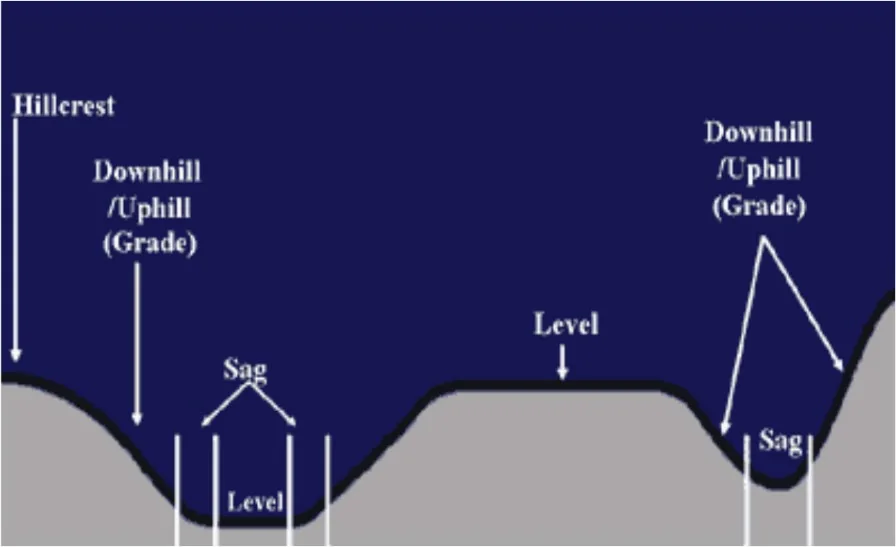
| 100b | Road Character, Grade | 04 Level, 05 Down Hill, 06 Up Hill, 07 Hill Crest, 08 Sag (Bottom) |
| 101 | Road Surface Type | 01 Concrete, 02 Blacktop, 03 Gravel, 04 Steel Grid, 05 Dirt |
| 102 | Road Surface Condition | 01 Dry, 02 Wet, 03 Snowy, 04 Icy, 05 Slush, 06 Water (standing or moving), 07 Sand, 08 Oil / Fuel, 09 Mud, Dirt, Gravel |
| 103 | Environmental Condition | 01 Clear, 02 Rain, 03 Snow, 04 Fog / Smog / Smoke, 05 Overcast, 06 Sleet / Hail, 07 Freezing Rain, 08 Blowing Snow, 09 Blowing Sand / Dirt, 10 Severe Crosswinds |
Crash type codes (Box 105)
| Code | Crash type |
|---|---|
| 01 | Same Direction, Rear End |
| 02 | Same Direction, Sideswipe |
| 03 | Right Angle |
| 04 | Opposite Direction, Head On / Angular |
| 05 | Opposite Direction, Sideswipe |
| 06 | Struck Parked Vehicle |
| 07 | Left Turn / U-Turn |
| 08 | Backing |
| 09 | Encroachment |
| 10 | Overturn |
| 11 | Fixed Object |
| 12 | Animal |
| 13 | Pedestrian |
| 14 | Pedalcyclist |
| 15 | Non-fixed Object |
| 16 | Railcar, Vehicle |
Codes 01 to 09 are used when the first event was a collision with another motor vehicle. Codes 10 to 16 are used when the first event was something else, such as an overturn, a fixed object or a pedestrian. The manual illustrates each type:
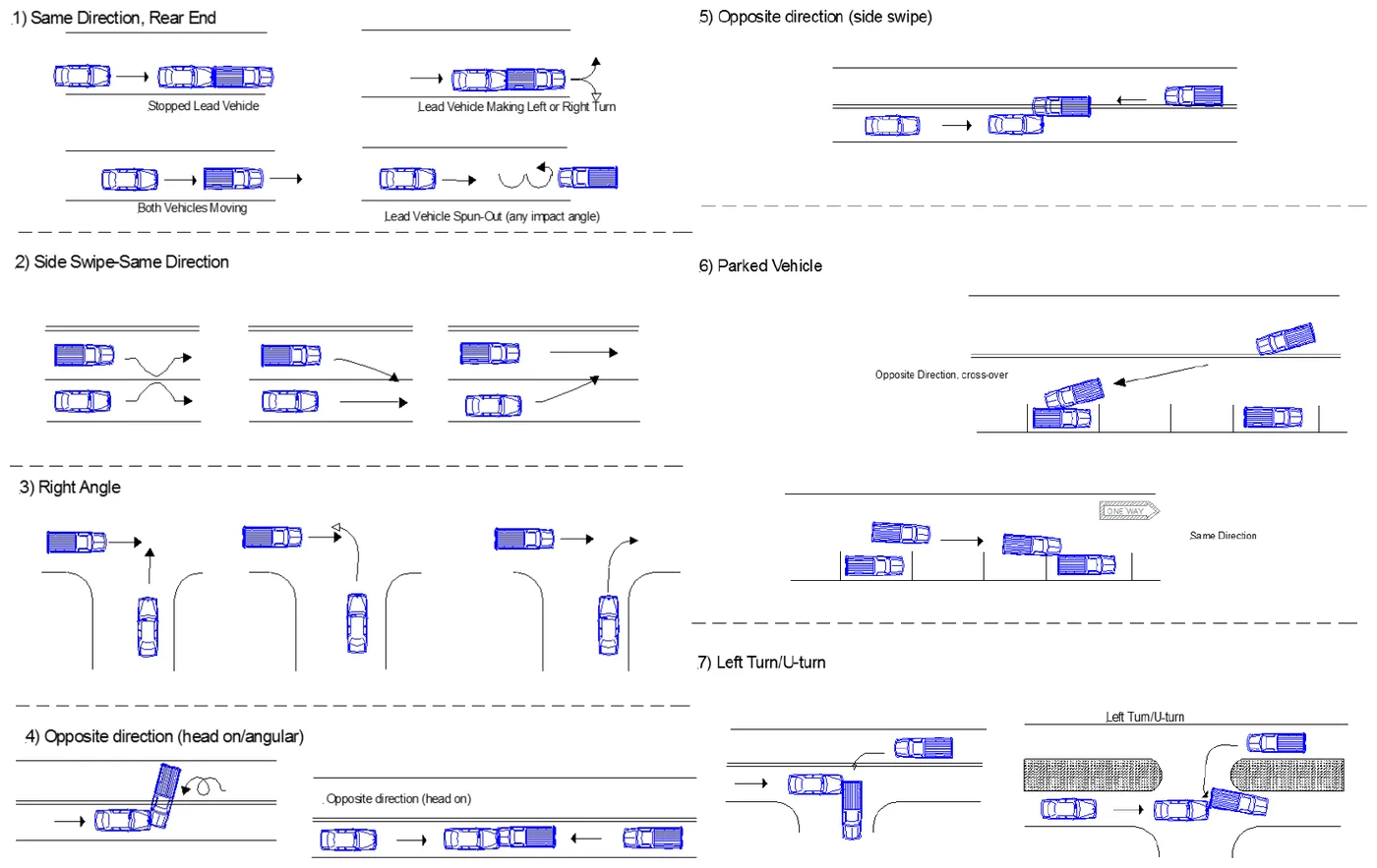
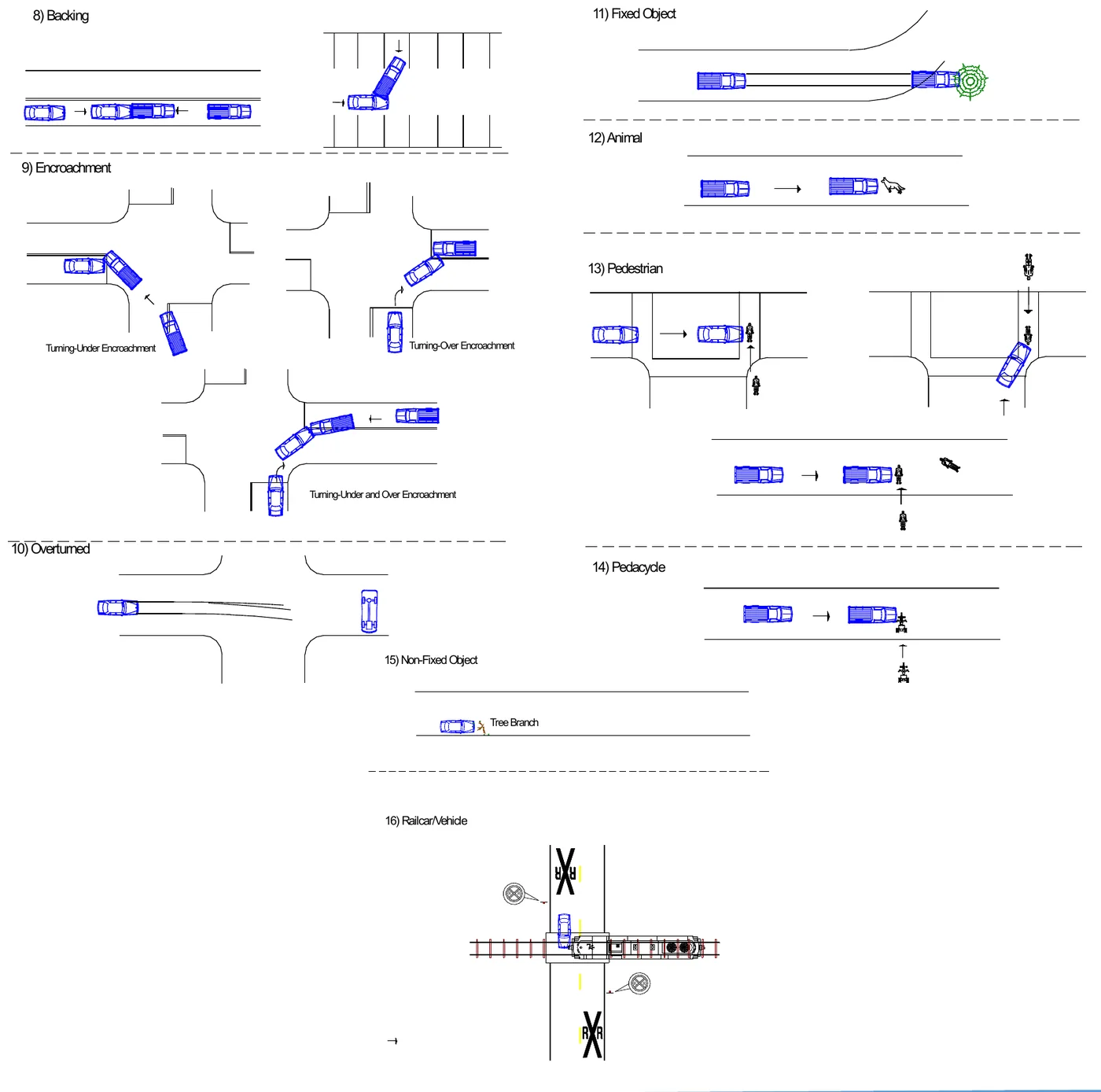
Vehicle type and use codes (Boxes 104 to 117)
| Box | Field | Official codes |
|---|---|---|
| 104 | Total Number of Motor Vehicles Involved | A count, not a code |
| 106, 107 | Oversized / Overweight Permit (overweight trucks only) | 01 Yes, 02 No |
| 108, 109 | Vehicle Type, passenger vehicles | 01 Car / Station Wagon / Minivan, 02 Passenger Van (9 or fewer seats), 03 Cargo Van (10,000 lbs. or less), 04 Sport Utility Vehicle, 05 Pickup, 06 Recreational Vehicle, 07 All Terrain Vehicle, 08 Motorcycle, 10 Any Previous with Trailer, 11 Motorized Bicycle (Moped), 12 Streetcar / Trolley, 13 Pedalcycle, 14 Golf Cart, 15 Low Speed Vehicle, 16 Snowmobile, 17 Personal Conveyance (such as low-speed e-scooters and e-bikes), 19 Other Passenger Vehicle* |
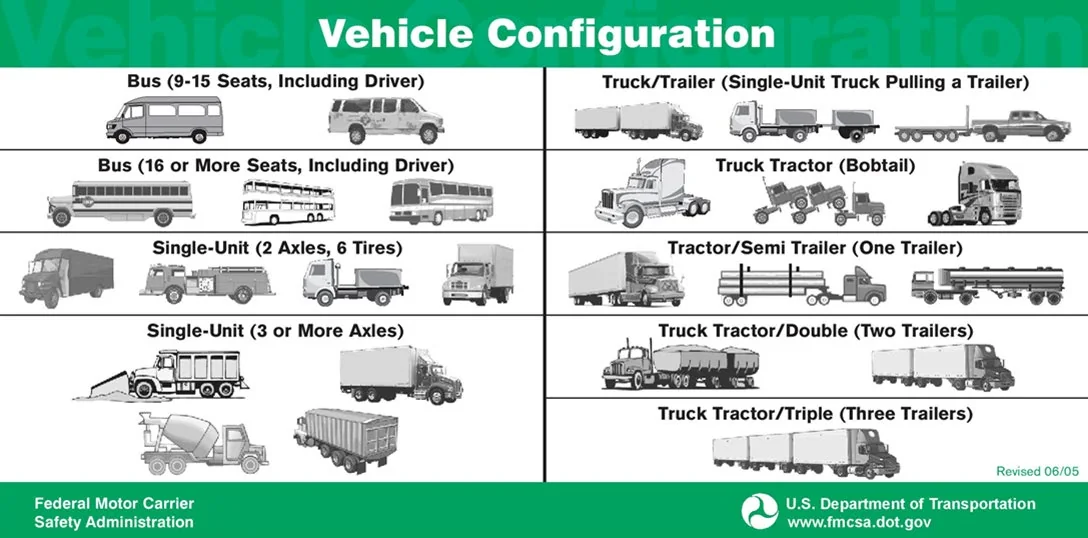
| 108, 109 | Vehicle Type, trucks, buses and other | 20 Single Unit (2 axle), 21 Single Unit (3+ axle), 22 Truck 2 Axle with Trailer, 23 Truck 3+ Axle with Trailer, 24 Truck Tractor (Bobtail), 25 Tractor Semi-Trailer, 26 Tractor Double, 27 Tractor Triple, 29 Other Truck*, 30 Bus / Large Van / Limo (9 to 15 seats), 31 Bus (more than 15 seats), 40 Equipment / Machinery |
| 110, 111 | Vehicle Use | 01 Personal, 02 Business / Commerce, 03 Government, 04 Responding to Emergency, 05 Machinery in Use |
| 112, 113 | Special Function Vehicles | 01 Work Equipment, 02 Police, 03 Military, 04 Fire / Rescue, 05 Ambulance, 06 Taxi / Limo, 07 Vehicle Used as School Bus, 08 Vehicle Used as Other Bus, 09 School Bus, 10 Transit Bus, 11 Tour Bus, 12 Shuttle Bus, 13 Intercity Bus, 14 Other Bus, 15 Vehicle Used as Snowplow, 16 Tow Truck, 17 Farm Equipment, 18 Farm Vehicle, 19 Construction / Off Road Equipment, 20 Rental Truck (over 10,000 lbs.), 21 Electronic Ride Share |
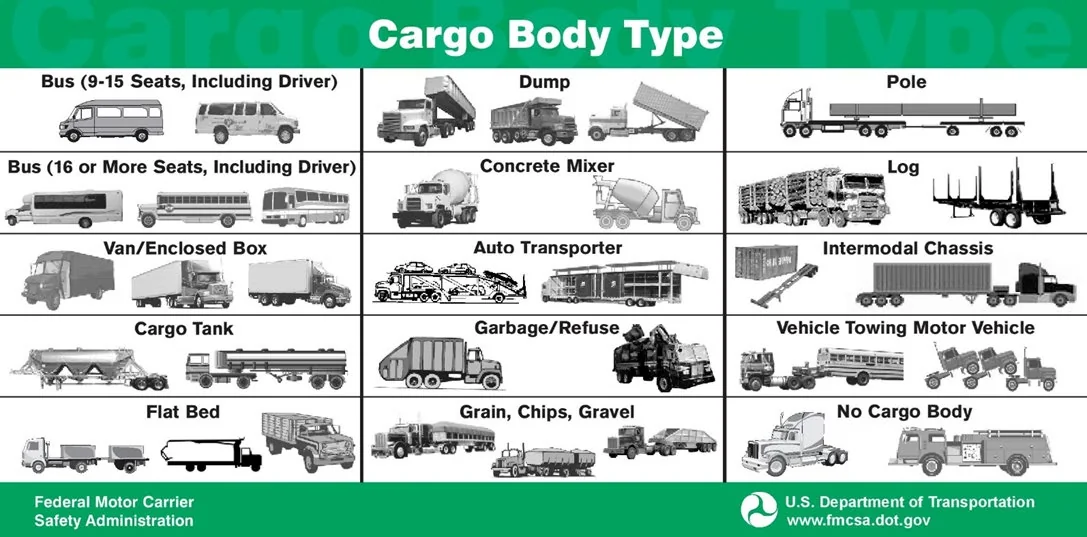
| 114, 115 | Cargo Body Type (trucks and buses only) | 01 Bus (9 to 15 seats), 02 Bus (more than 15 seats), 03 Van / Enclosed Box, 04 Cargo Tank, 05 Flatbed, 06 Dump, 07 Concrete Mixer, 08 Auto Transporter, 09 Garbage / Refuse, 10 Hopper (grain, gravel, chips), 11 Pole / Log (Trailer), 12 Intermodal Chassis, 13 No Cargo Body, 14 Vehicle Towing Another Vehicle |
| 116, 117 | Direction of Travel | 01 North, 02 East, 03 South, 04 West |
Two codes deserve a second look in an injury case. Vehicle type 17 Personal Conveyance covers low-speed e-scooters and e-bikes, and 13 Pedalcycle covers bicycles. Special function 21 Electronic Ride Share marks an Uber, Lyft or similar car, and 20 Rental Truck (over 10,000 lbs.) marks a large rental truck. Vehicle use 02 Business / Commerce can point to an employer's commercial policy.
Contributing circumstance codes (Boxes 118 and 119)
The officer picks up to two "apparent contributing circumstances" for each driver: Box 118 A and B for Vehicle 1, Box 119 A and B for Vehicle 2. The manual tells officers to choose the most prominent factors even if no summons is issued. Codes marked with an asterisk (*) must be explained in the Box 145 narrative. Adjusters lean heavily on these codes when they first decide fault.
Human and driver actions (01 to 29)
| Code | Circumstance |
|---|---|
| 01 | Unsafe Speed |
| 02 | Driver Inattention* |
| 03 | Failed to Obey Traffic Signal |
| 04 | Failed to Yield Right of Way to Vehicle / Pedestrian |
| 05 | Improper Lane Change |
| 06 | Improper Passing |
| 07 | Improper Use / Failed to Use Turn Signal |
| 08 | Improper Turning |
| 09 | Following Too Closely |
| 10 | Backing Unsafely |
| 11 | Improper Use / No Lights |
| 12 | Wrong Way |
| 13 | Improper Parking |
| 14 | Failure to Keep Right |
| 15 | Failure to Remove Snow / Ice |
| 16 | Failure to Obey Stop Sign |
| 17 | Distracted, Hand Held Electronic Device* |
| 18 | Distracted, Hands Free Electronic Device* |
| 19 | Distracted by Passenger* |
| 20 | Other Distraction Inside Vehicle* |
| 21 | Other Distraction Outside Vehicle* |
| 25 | None |
| 29 | Other Driver / Pedalcyclist Action* |
Vehicle factors (31 to 49)
| Code | Circumstance |
|---|---|
| 31 | Defective Lights |
| 32 | Brakes* |
| 33 | Steering* |
| 34 | Tire* |
| 35 | Wheels* |
| 36 | Windows / Windshield* |
| 37 | Mirrors |
| 38 | Wipers |
| 39 | Vehicle Coupling / Hitch / Safety Chains* |
| 49 | Other Vehicle Factor* |
Road and environmental factors (51 to 69)
| Code | Circumstance |
|---|---|
| 51 | Road Surface Condition* |
| 52 | Obstruction / Debris on Road* |
| 53 | Ruts, Holes, Bumps* |
| 54 | Traffic Control Device Defective / Missing* |
| 55 | Improper Work Zone* |
| 56 | Physical Obstruction(s) (viewing, etc.)* |
| 57 | Animal(s) in Roadway* |
| 58 | Improper / Inadequate Lane Markings* |
| 59 | Sun Glare* |
| 60 | Traffic Congestion, Prior Incident* |
| 61 | Traffic Congestion, Regular* |
| 69 | Other Roadway Factors* |
A road or signal defect code (51 to 58) can point to a claim against a town, county or the State. Those claims need a written notice within 90 days under the New Jersey Tort Claims Act.
Pedestrian factors (71 to 89)
| Code | Circumstance |
|---|---|
| 71 | Failed to Obey Traffic Control Device |
| 72 | Crossing Where Prohibited |
| 73 | Dark Clothing / Low Visibility to Driver |
| 74 | Inattentive* |
| 75 | Failure to Yield Right of Way |
| 76 | Walking on Wrong Side of Road |
| 77 | Walking in Road When Sidewalk Is Present |
| 78 | Running / Darting Across Traffic |
| 85 | None |
| 89 | Other Pedestrian Factors* |
Driver condition, pre-crash action and traffic controls (Boxes 120 to 125)
Apparent physical status (Boxes 120 and 121)
The officer picks at least one and up to two codes for each driver, cyclist or pedestrian, based on observations, odor, statements and the evidence at the scene. The manual is clear that this box does not require a breath, blood or urine test. When drugs or medication are coded, the officer is supposed to name the drug or medication in the narrative.
| Code | Physical status |
|---|---|
| 01 | Apparently Normal |
| 02 | Alcohol Use |
| 03 | Drug Use (Illicit)* |
| 04 | Medication |
| 05 | Alcohol and Drug / Medication Use* |
| 06 | Physical Handicaps |
| 07 | Illness |
| 08 | Fatigue |
| 09 | Fell Asleep |
| 10 | Cannabinoid Use (added in 2023) |
Why it matters: an alcohol, drug or cannabinoid code can support a claim that the other driver was impaired, and may lead to a claim against a bar or restaurant that over-served a visibly intoxicated driver under New Jersey's Licensed Alcoholic Beverage Server Fair Liability Act (N.J.S.A. 2A:22A-1 and following). Fatigue and fell-asleep codes matter too, especially in truck crashes, where hours-of-service logs can be requested. Because the code is the officer's impression, the test results and the officer's observations in the narrative carry more weight.
Pre-crash action (Boxes 122 and 123)
Vehicles and pedalcyclists use codes 01 to 29. Pedestrians use codes 31 to 49.
| Code | Vehicle / cyclist action |
|---|---|
| 01 | Going Straight Ahead |
| 02 | Making Right Turn (not turn on red) |
| 03 | Making Left Turn |
| 04 | Making U Turn |
| 05 | Starting From Parking |
| 06 | Starting in Traffic |
| 07 | Slowing or Stopping |
| 08 | Stopped in Traffic |
| 09 | Parking |
| 10 | Parked |
| 11 | Changing Lanes |
| 12 | Merging / Entering Traffic Lane |
| 13 | Backing |
| 14 | Driverless / Moving |
| 15 | Passing |
| 16 | Negotiating Curve |
| 17 | Driving on Shoulder |
| 18 | Right Turn on Red |
| 19 | Deliberate Action* |
| 29 | Other Vehicle / Cyclist Action* |
| Code | Pedestrian action |
|---|---|
| 31 | Pedestrian Off Road |
| 32 | Walking To / From School |
| 33 | Walking / Jogging With Traffic |
| 34 | Walking / Jogging Against Traffic |
| 35 | Playing in Road |
| 36 | Standing / Lying / Kneeling in Road |
| 37 | Getting On / Off Vehicle |
| 38 | Pushing / Working on Vehicle |
| 39 | Other Working in Roadway |
| 40 | Approaching / Leaving School Bus |
| 41 | Coming From Behind Parked Vehicle |
| 42 | Crossing / Jaywalking |
| 43 | Crossing at "Marked" Crosswalk at Intersection |
| 44 | Crossing at "Unmarked" Crosswalk at Intersection |
| 45 | Crossing at "Marked" Crosswalk at Mid-Block |
| 46 | Deliberate Action* |
| 49 | Other Pedestrian Action* |
Why it matters: 08 Stopped in Traffic or 10 Parked for your vehicle is strong support in a rear-end or parked-car claim. For pedestrians, 43 to 45 (crossing in a marked or unmarked crosswalk) can be powerful, because the manual follows New Jersey law in treating every intersection as an unmarked crosswalk, and drivers must stop for pedestrians in crosswalks (N.J.S.A. 39:4-36). A 42 Crossing / Jaywalking code is not the end of a pedestrian claim under New Jersey's comparative negligence rule.
Traffic controls (Boxes 124 and 125)
| Code | Traffic control |
|---|---|
| 01 | Police Officer |
| 02 | Railroad Watchman, Gates, etc. |
| 03 | Traffic Signal |
| 04 | Lane Markings |
| 05 | Channelization, Painted |
| 06 | Channelization, Physical |
| 07 | Warning Signal |
| 08 | Stop Sign |
| 09 | Yield Sign |
| 10 | Flagman |
| 11 | No Control Present |
| 12 | Flashing Traffic Control |
| 13 | School Zone (Signs / Controls) |
| 14 | Adult Crossing Guard |
One code is entered for each vehicle. The manual notes that the first vehicle in line is controlled by the signal or sign, while vehicles behind it may be controlled by the lane markings, so two cars at the same corner can have different codes.
Sequence of events, impact points and damage (Boxes 126 to 135)
In Boxes 126 and 127 the officer lists up to four events, in order, for each vehicle, then marks which one was the most harmful event: the one that caused the most severe injury or, without an injury, the most damage. Box 128 is the first harmful event for the whole crash, the first event that caused injury or damage. Events marked ** cannot be the first or most harmful event, and events marked * must be explained in the narrative.
Non-collision events (01 to 19)
| Code | Event |
|---|---|
| 01 | Overturn / Rollover |
| 02 | Fire / Explosion |
| 03 | Immersion |
| 04 | Jackknife |
| 05 | Ran Off Road, Right** |
| 06 | Ran Off Road, Left** |
| 07 | Cross Median** |
| 08 | Crossed Centerline** |
| 09 | Cargo / Equipment Loss or Shift |
| 10 | Separation of Units** |
| 11 | Fell / Jumped From Vehicle |
| 12 | Thrown / Falling Object |
| 13 | Equipment Failure (blown tire, brake failure, etc.)** |
| 14 | Downhill Runaway** |
| 15 | Reentered Roadway** |
| 19 | Other Non-Collision* |
Collision with a person, motor vehicle or non-fixed object (21 to 39)
| Code | Event |
|---|---|
| 21 | Pedalcyclist |
| 22 | Pedestrian |
| 23 | Train / Trolley / Other Railcar |
| 24 | Deer |
| 25 | Other Animal |
| 26 | Motor Vehicle in Transport |
| 27 | Motor Vehicle in Transport, Other Roadway |
| 28 | Parked Motor Vehicle |
| 29 | Work Zone / Maintenance Equipment |
| 30 | Struck by Object Set in Motion by a Motor Vehicle |
| 39 | Other Non-Fixed Object* |
Collision with a fixed object (41 to 69)
| Code | Event |
|---|---|
| 41 | Impact Attenuator / Crash Cushion |
| 42 | Bridge Overhead Structure |
| 43 | Bridge Pier or Support |
| 44 | Bridge Parapet End |
| 45 | Bridge Rail |
| 46 | Guide Rail Face |
| 47 | Guide Rail End |
| 48 | Concrete Traffic Barrier |
| 49 | Other Traffic Barrier |
| 50 | Traffic Sign Support |
| 51 | Traffic Signal Standard |
| 52 | Utility Pole |
| 53 | Light Standard |
| 54 | Other Post, Pole, Support |
| 55 | Culvert |
| 56 | Curb |
| 57 | Ditch |
| 58 | Embankment |
| 59 | Fence |
| 60 | Tree |
| 61 | Mailbox |
| 62 | Fire Hydrant |
| 69 | Other Fixed Object* (walls, buildings, tunnels, etc.) |
Why it matters: the sequence shows how a crash unfolded. A car that was 26 Motor Vehicle in Transport and then 60 Tree tells a different story than one that ran off the road first. Guide rail, barrier, sign and signal codes (46 to 51) can matter in a claim about a damaged or poorly placed roadside device, and 29 Work Zone / Maintenance Equipment can bring in a contractor.
Impact points and damage (Boxes 129 to 135)
Boxes 129 to 132 record two things for each vehicle using a clock face: the initial point of impact, where contact first began, and the area of principal damage, where the vehicle was damaged most. For example, if Vehicle 1 rear-ends Vehicle 2, Vehicle 1's impact point is 12 and Vehicle 2's is 6.
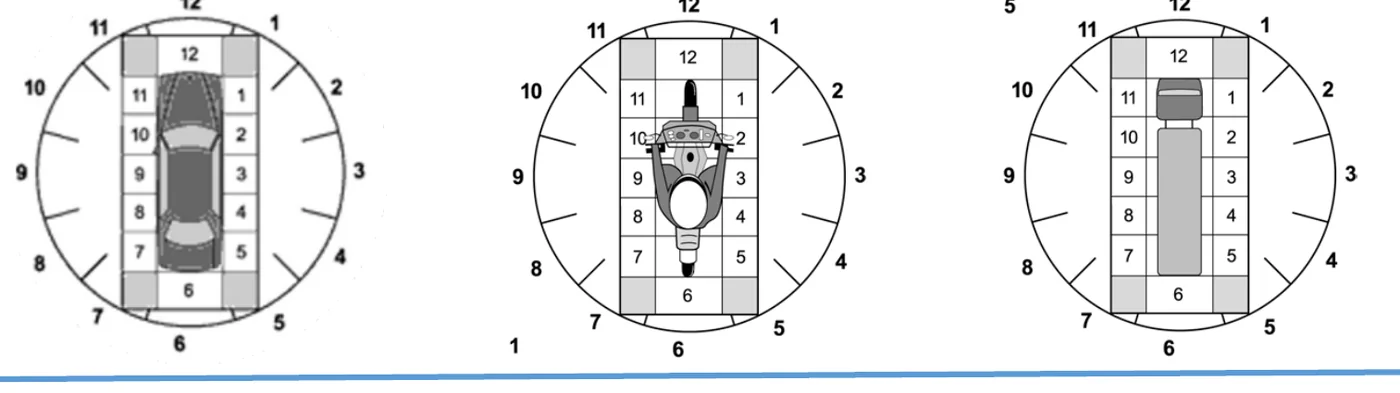
| Code | Impact area |
|---|---|
| 01 to 12 | Clock position on the vehicle, with 12 at the front center and 6 at the rear center |
| 13 | Roof |
| 14 | Undercarriage |
| 15 | Overturned |
| 17 | None Visible |
Extent of damage (Boxes 133 and 134)
| Code | Extent of damage |
|---|---|
| 01 | None |
| 02 | Minor: does not affect the operation of the vehicle or disable it |
| 03 | Moderate / Functional: not disabling, but affects the operation of the vehicle or its parts |
| 04 | Disabling: the vehicle could not leave the scene in its usual way after simple repairs and had to be towed, carried or helped by an emergency vehicle |
Why it matters: impact points are physical evidence that can confirm or contradict each driver's story. A side impact at 3 or 9 o'clock, for instance, is hard to square with a claim of a rear-end crash. Insurers also use the damage code to argue about how hard the impact was. A "Minor" code does not mean a minor injury, and repair estimates and photos give a far better picture of the force involved. Box 135 lists damage to other property, such as fences, lawns and hydrants, with the property owner's name and address.
Driver-assist and self-driving boxes (Boxes 150 to 153)
Since 2023, the NJTR-1 records the level of driving automation each vehicle has (Boxes 150 and 151) and the level that was engaged at the time of the crash (Boxes 152 and 153), using the Society of Automotive Engineers levels. At levels 0 to 2, the human driver monitors the road. At levels 3 to 5, the automated system does.
| Level | What it means |
|---|---|
| 0 | No Automation: the human driver does all of the driving, even with warning or intervention systems |
| 1 | Driver Assistance: a system handles steering or speed (not both), and the human does the rest |
| 2 | Partial Automation: a system handles both steering and speed, and the human does the rest and must watch the road |
| 3 | Conditional Automation: the system drives, and the human must respond when asked to take over |
| 4 | High Automation: the system drives even if the human does not respond to a request to take over |
| 5 | Full Automation: the system drives full time on all roads and in all conditions a human could manage |
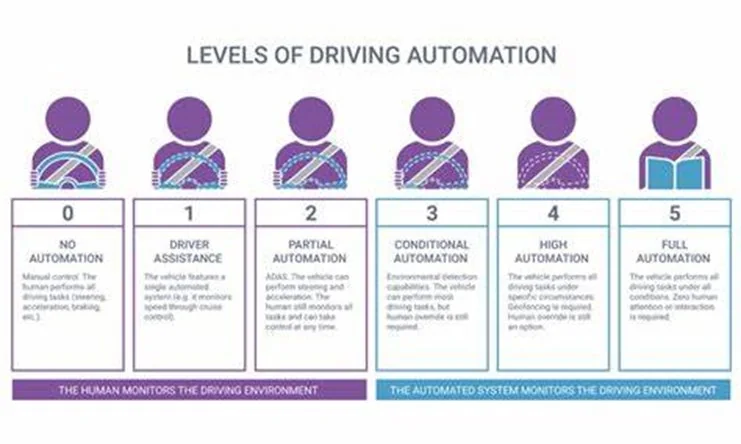
Why it matters: most cars sold today with adaptive cruise control and lane-centering are Level 1 or Level 2, which means the human driver was still responsible for watching the road. If these boxes show a system was engaged, the vehicle's data, the system's design and the manufacturer may become part of the case, and the vehicle should be preserved before it is repaired or sold.
Insurance company codes (Boxes 25 and 55)
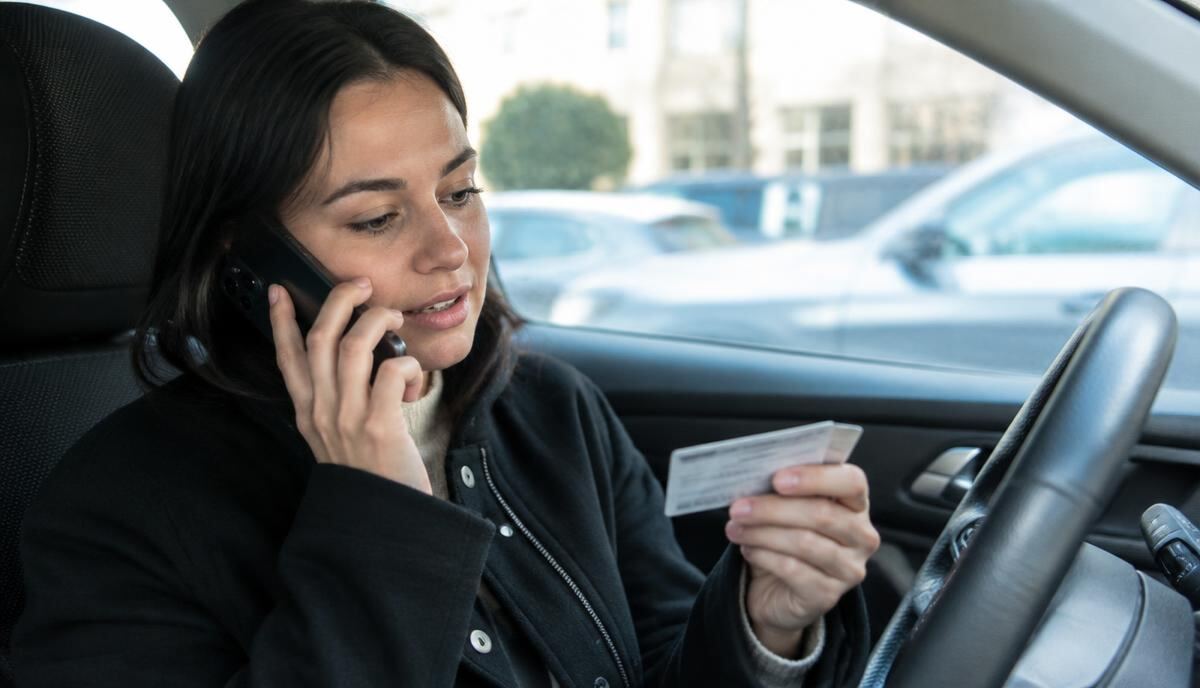
Instead of writing out the insurance company's name, the officer copies a three-digit code from each driver's New Jersey insurance ID card into Box 25 (Vehicle 1) or Box 55 (Vehicle 2). The New Jersey Motor Vehicle Commission assigns these codes. For example, 012 is Allstate New Jersey Insurance Co. and 100 is GEICO Indemnity Co. An asterisk (*) means the code was unknown, the car was registered out of state or self-insured, or the vehicle may be uninsured; the officer explains which in Box 145. Check the code against the card you photographed, because a wrong code sends your claim to the wrong company.
Look up any code in our full NJ insurance company code lookup.
When a crash counts as "at-fault" for your insurance
The NJTR-1 manual reprints the New Jersey insurance rule that defines an "at-fault accident" for auto insurance purposes (N.J.A.C. 11:3-34.3). This is the definition insurers use for things like premium surcharges. It is separate from the officer's codes and separate from who wins an injury case.
Under the rule as printed in the manual, a crash is at-fault for a driver on your policy only when both of these are true:
- The driver was proportionately responsible: at least 50% responsible in a two-driver crash, at least 33 1/3% in a three-driver crash, and so on.
- The insurer paid at least $1,000 for a crash on or after June 9, 2003 ($500 before that date). The rule allows this amount to be adjusted for inflation by order of the Commissioner, no more than every 36 months.
Even when those are true, a crash is not at-fault if:
- Your vehicle was lawfully parked.
- You were hit by a hit-and-run driver, and the crash was reported to the proper authorities within 24 hours.
- No driver on your policy was convicted of a moving violation for the crash, and the other driver was.
- The loss was a physical damage loss other than collision.
- You were struck in the rear by another vehicle, and no driver on your policy was convicted of a moving violation for the crash.
- The driver was responding to an emergency call as a paid or volunteer member of a police or fire department, first aid squad or law enforcement agency.
Why it matters: the hit-and-run exclusion only applies if the crash was reported within 24 hours, which is one more reason to call the police right away. The rear-end and "other driver convicted" exclusions tie back to the summonses in Boxes 136 to 143 and what happens in municipal court. Insurers can apply the rule differently, and the dollar threshold can change, so check your own policy and ask your insurer how it classified the crash.
Does the police report automatically go to insurance?
No. The police file the NJTR-1 with the State, not with your insurance company. What usually happens is that an insurer orders a copy itself once someone opens a claim, the same way you would, using the case number, date and location. That means the report does not start a claim for you, and it does not tell your insurer that you were hurt.
You still need to notify your own auto insurer promptly. In New Jersey, your own policy's Personal Injury Protection (PIP) usually pays your medical bills first, no matter who caused the crash, and policies require prompt notice. Give the insurer the case number and the other driver's information from the report. If you were hurt, think carefully before giving a recorded statement to the other driver's insurer; that company is not on your side.
7 common mistakes on police reports (and how to spot them)
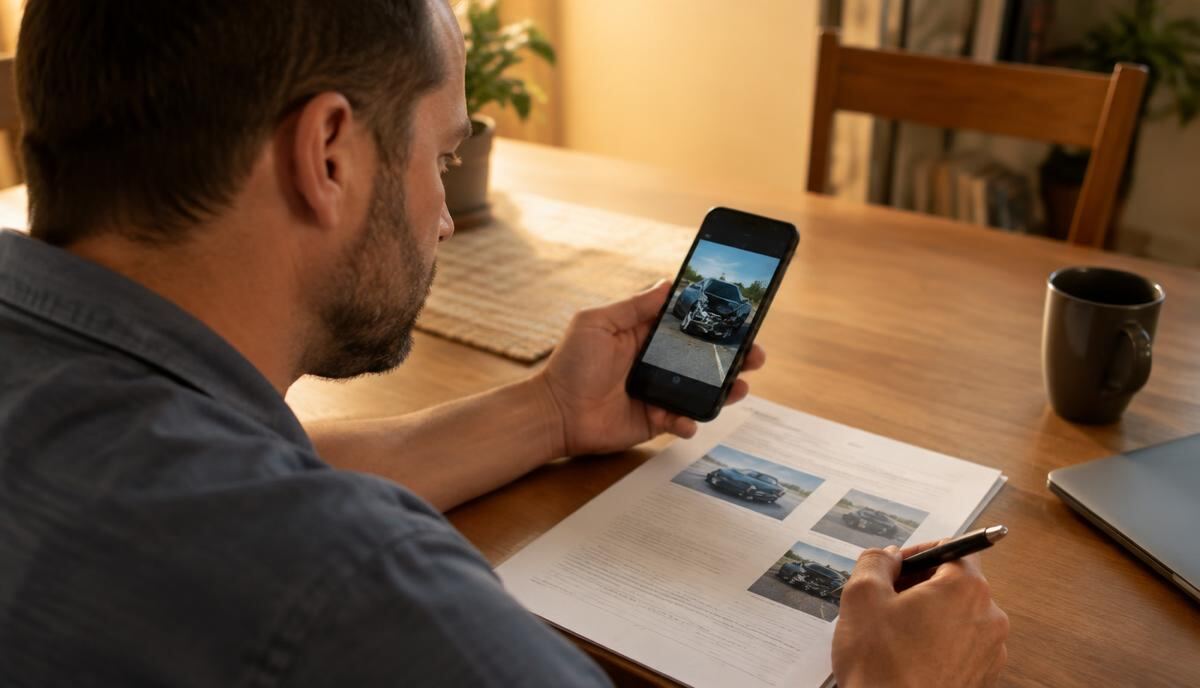
What to photograph at the scene
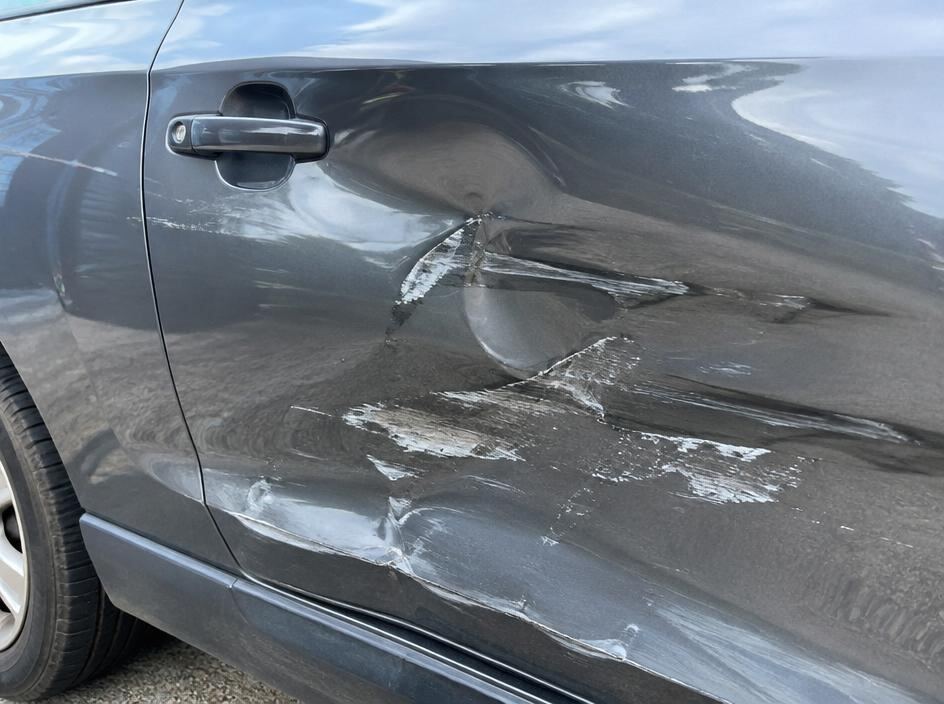
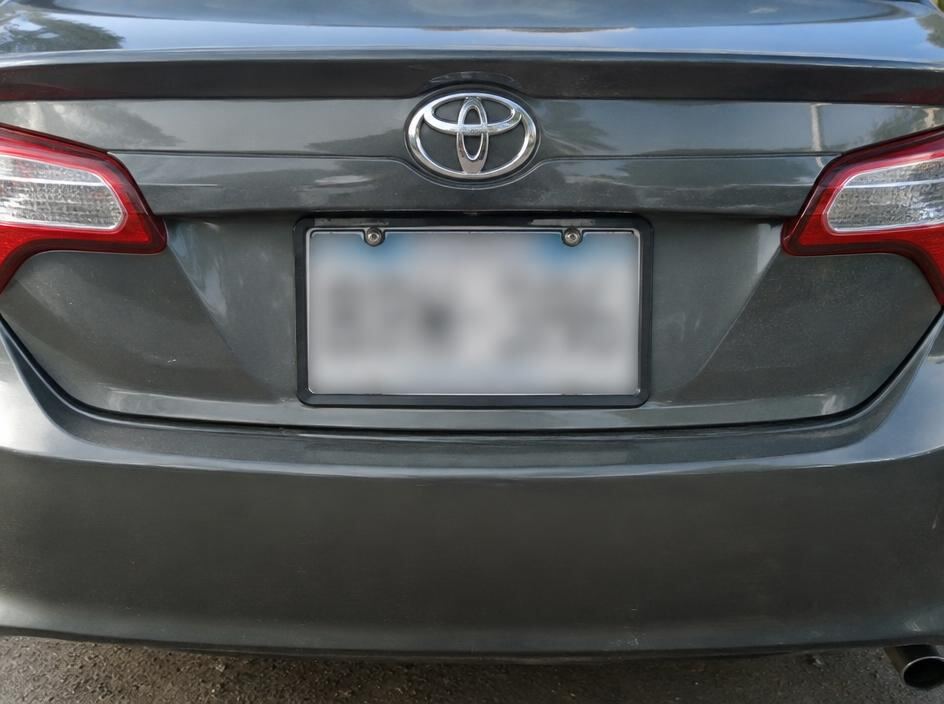
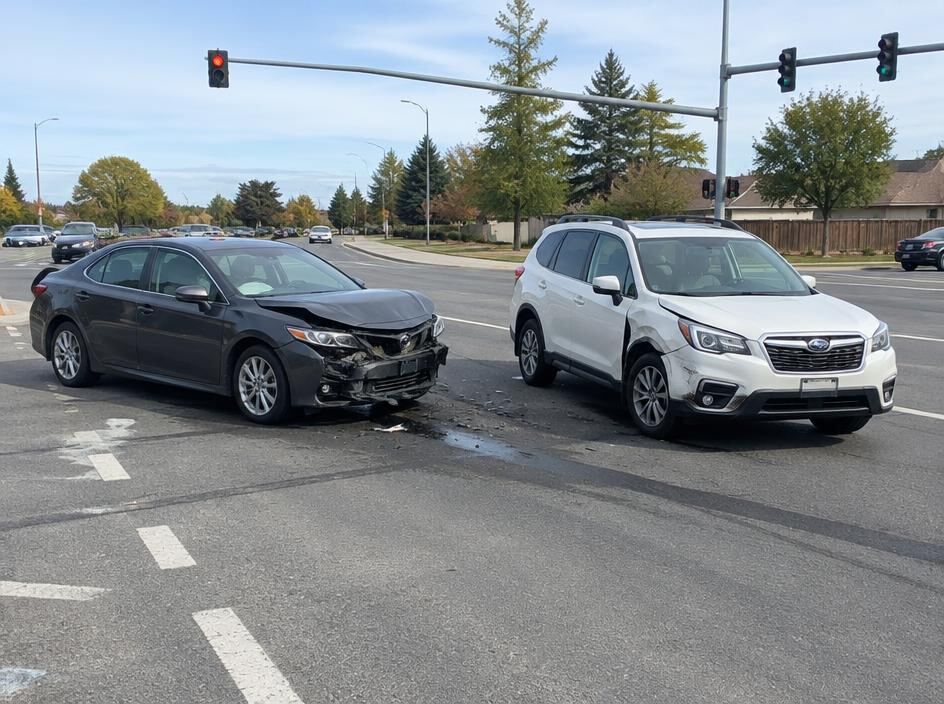
These photos are your best proof when a report gets a plate, direction or location wrong.
Officers write reports quickly, often at the roadside and from several people's accounts. These are the mistakes we see most, and what to look for:
- Wrong vehicle number. Your car is listed as Vehicle 1 or Vehicle 2 the wrong way round, so your details, injuries or codes sit under the other driver's column.
- Wrong direction of travel. The report or diagram shows you heading the wrong way or in the wrong lane, which can flip how an adjuster reads the crash.
- "No injury" when an injury appeared later. Box 86 says 05 No Apparent Injury, but pain or symptoms started hours or days later. Your medical records, not the scene code, show the injury.
- Missing witness. A witness who stopped and talked to the officer is not listed, or their contact details are wrong.
- Wrong insurer. The three-digit insurance code in Box 25 or 55, or the policy number, does not match the driver's insurance card.
- Wrong diagram. The sketch puts the point of impact, lane positions or traffic signals in the wrong place.
- Wrong contributing circumstance. Box 118 or 119 blames you for something you did not do, or leaves out what the other driver did, such as 17 hand-held phone use.
What if the report is wrong?
You can often get a factual mistake fixed. What you usually cannot change is the officer's opinion, such as who caused the crash or which contributing circumstance codes were chosen. Here is the step-by-step process:
- Read the whole report. Check every name, plate, policy number, insurance code, direction of travel, the diagram and the narrative against what you know happened.
- Sort factual errors from opinions. Factual errors (a wrong plate, a misspelled name, the wrong insurer, the wrong vehicle number) can usually be corrected. The officer's opinion, such as the contributing circumstance codes or who caused the crash, usually is not changed.
- Gather proof. Collect what shows the correct fact: your license, registration and insurance card, photos, dashcam video, repair estimates, medical records and witness names.
- Contact the department that wrote the report. Call or write to the records bureau of the police department that investigated, or the State Police station for a State Police report. Ask how they handle corrections and who the reporting officer's supervisor is.
- Ask in writing for a correction. Send a short, polite letter or email with the case number, the date, the exact box that is wrong, what it should say and copies of your proof. Ask for a supplemental or corrected report.
- Attach a supplemental statement. If the officer will not change a disputed point, ask that your own written statement be added to the file. Keep it factual and short, and keep a copy.
- Follow up and share the update. Request a copy of the corrected or supplemented report and send it to your insurer and your lawyer. Act early, because camera video and memories fade quickly.
- Can usually be corrected: wrong plate, misspelled name, wrong insurance code or policy number, wrong vehicle number, wrong date or location.
- Usually stays as written: the officer's opinion about fault, the contributing circumstance codes and the injury code chosen at the scene. Your supplemental statement, witness statements, photos, dashcam or traffic camera video and vehicle data can still overcome a bad report.
- Act early. Business and traffic camera video is often overwritten within days or weeks.
Free download
Police Report Error Checklist
A one-page checklist of the 7 most common crash report mistakes, with a box to tick for each one. Print it and check your report line by line.
No email needed: download the PDF directly.
The diagram and the narrative (Boxes 144 and 145)
The officer draws the crash in Box 144 showing north, lanes, directions of travel and the point of impact, then writes the narrative in Box 145. The narrative should summarize what each driver and witness said and list witness contact details. Read it closely: if your statement was recorded wrong, that is the most important thing to correct.
Summonses (Boxes 136 to 143)
If a driver got a ticket, the report lists which driver was charged and the statute, most serious charge first, for example N.J.S.A. 39:4-89 for following too closely. Up to four charges fit in the boxes; any more go in the narrative. A ticket helps, but whether a driver was negligent is decided separately in the injury case.
Can the police report be used in court?
Insurance companies treat the report as a key document, and it is used constantly in settlement talks. At trial the rules are stricter. Facts the officer personally observed may come in, while the officer's opinion about who caused the crash, or statements from people who are not testifying, are often kept out under the hearsay and opinion rules. Fault is decided on the evidence as a whole under New Jersey's comparative negligence rule.
What to do with the report now
- Check every name, plate, policy number and insurance code.
- Give it to your own insurer so your PIP benefits can start.
- Be careful what you say to the other driver's insurer. See what not to tell an insurance company.
- Keep your photos, witness names and medical records with it.
If you were hurt and the report is confusing or wrong, a New Jersey car accident lawyer can request the full file, check the codes and preserve the evidence that matters.
Frequently asked questions
What is an NJTR-1?
The NJTR-1 is the New Jersey Police Crash Investigation Report, the standard form every police agency in the state uses to document a reportable crash. Officers must forward it within five days of the investigation under N.J.S.A. 39:4-131.
How do I get a copy of my New Jersey crash report?
Ask the agency that investigated. State Police, Turnpike and Garden State Parkway reports are sold online at njportal.com/njsp/crashreports ($13 for non-toll roads, $5 for toll roads). Local police reports come from that department's records bureau or its online request link.
How long does it take for a NJ crash report to be ready?
The State Police portal says requests can take up to 14 business days, depending on when the report is approved. Local departments vary. A report cannot be found until a supervisor approves it.
What does the insurance code on my police report mean?
Boxes 25 and 55 hold a three-digit code assigned by the New Jersey Motor Vehicle Commission to each insurance company. It is copied from the NJ insurance ID card. An asterisk means the insurer was unknown, out of state, self-insured or possibly uninsured.
What do the injury codes 01 to 05 mean in Box 86?
Box 86 uses the national KABCO scale: 01 Fatal Injury (K), 02 Suspected Serious Injury (A), 03 Suspected Minor Injury (B), 04 Possible Injury (C) and 05 No Apparent Injury (O). It records what the officer saw at the scene, not a medical diagnosis.
Does the contributing circumstance code decide who was at fault?
No. Boxes 118 and 119 record the officer's opinion of what apparently contributed to the crash. Insurers rely on them, but fault in an injury case is decided on all of the evidence under New Jersey's comparative negligence law.
What does Vehicle 1 mean on a police report?
It is the order the officer listed the vehicles. Vehicle 1 is often the vehicle the officer believes started the crash sequence, but the number is not a finding of fault.
What if my crash report is wrong?
Ask the department in writing to correct factual mistakes such as a wrong plate, name or insurer through a supplemental report. Officers rarely change opinions, but photos, video, witnesses and vehicle data can overcome a mistaken report.
What does a police report look like?
A New Jersey crash report is the NJTR-1: a multi-page form with 153 numbered boxes. The top covers the crash details, then each vehicle and driver, each injured person, the road and crash codes, and finally a hand-drawn diagram and the officer's written narrative.
Is a police report a finding of fault?
No. The report is the officer's account of what they saw and were told, written after the fact. Insurers rely on it, but legal fault is decided on all of the evidence, and the officer's opinions are often kept out at trial.
Does a police report go to my insurance company automatically?
No. Insurers usually order the report themselves once a claim is open, but the report does not file a claim for you. You still have to notify your own insurer promptly so your PIP medical benefits can start.
Can I add my side of the story to the report?
Usually you can submit a written statement to the police department and ask that it be attached to the report as a supplement. The officer's original narrative normally stays, but your statement becomes part of the file.
Sources
- New Jersey Department of Transportation, NJTR-1 Crash Report Manual, Edition 2.0, effective January 1, 2023
- NJDOT, NJTR-1 codes (police department, municipality, insurance and hospital codes)
- New Jersey State Police and Turnpike Authority, Crash Report Requests portal and FAQ
- N.J.S.A. 39:4-130 and 39:4-131 (crash reporting), N.J.S.A. 39:4-36 (pedestrians in crosswalks)
- N.J.A.C. 11:3-34.3, definition of "at-fault accident," as reprinted in the NJTR-1 Crash Report Manual
- N.J.S.A. 2A:22A-1 and following, Licensed Alcoholic Beverage Server Fair Liability Act
- 49 C.F.R. Part 387, minimum levels of financial responsibility for motor carriers
- Vehicle configuration and cargo body charts: Federal Motor Carrier Safety Administration, as reproduced in the NJTR-1 manual. Levels of automation: Society of Automotive Engineers (SAE J3016), as summarized in the NJTR-1 manual.
Related: what to do after a car accident in NJ and getting a police report after a hit-and-run.
This article is general information about New Jersey crash reports, not legal advice. Codes, form pages and diagrams are taken from the 2023 NJTR-1 Crash Report Manual published by the New Jersey Department of Transportation; reports written before 2023 may use older codes. The "why it matters" notes are our general commentary, not part of the official manual.