
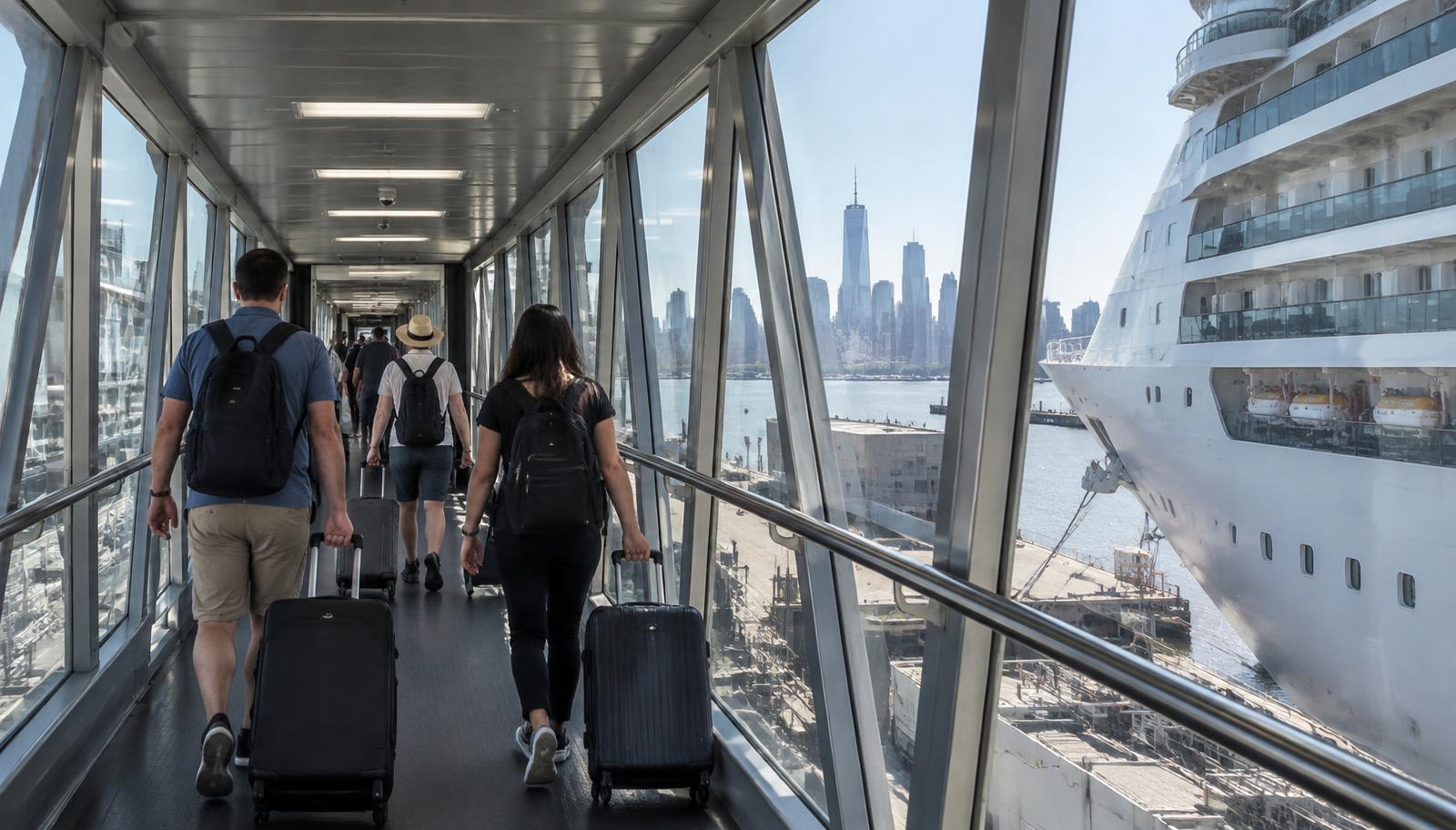
Not every cruise injury happens at sea. People trip in the check-in hall at Cape Liberty, fall on the boarding ramp in Manhattan or get hurt in the parking garage in Brooklyn. Who is responsible, and which deadlines apply, depends on who owns and runs that spot.
The short answer
- Cape Liberty (Bayonne) is owned by the Port Authority of New York and New Jersey and run with Royal Caribbean. Claims against the Port Authority need a notice of claim at least 60 days before suit and a lawsuit within 1 year (N.J.S.A. 32:1-163).
- Manhattan Cruise Terminal is a City of New York facility managed through NYCEDC and run by Ports America under contract.
- Brooklyn Cruise Terminal in Red Hook is also a City facility managed through NYCEDC.
- On the gangway or ship, the cruise line's ticket rules usually apply: notice within 6 months, suit within 1 year.
The three local terminals
Cape Liberty Cruise Port sits on the Peninsula at Bayonne Harbor, the former Military Ocean Terminal. The Port Authority acquired the terminal in 2010, and Royal Caribbean and the Port Authority developed the current terminal through a partnership. Royal Caribbean and Celebrity sail from there.
Manhattan Cruise Terminal, at 711 12th Avenue on the West Side, is a City-owned facility. NYCEDC says it is managed by Ports America, a private terminal company under contract with the City's agency. Ports America also provides terminal security there.
Brooklyn Cruise Terminal in Red Hook opened in 2006 and is also overseen by NYCEDC.
Who may be responsible
- The cruise line: for the ship, the gangway it controls, its check-in staff and anything it operates.
- The terminal operator: for floors, escalators, baggage areas, lines and security screening it runs.
- The property owner: a public agency may be responsible for structural defects or areas it maintains.
- Contractors: cleaning, baggage-handling, parking and shuttle companies.
Leases and operating agreements decide who maintained each area. That is often the first thing to investigate.
Land law or maritime law?
Courts have long treated the gangway as the rough dividing line between land and sea (Victory Carriers, Inc. v. Law, 404 U.S. 202 (1971)). In general:
- Injuries inside the terminal building, garage or sidewalk are usually governed by state premises law. New Jersey's general limit is two years (N.J.S.A. 2A:14-2), and New York's is generally three (N.Y. C.P.L.R. 214).
- Injuries on the gangway or the ship are usually maritime, and the ticket's 6-month and 1-year rules apply to claims against the cruise line (46 U.S.C. § 30526).
- Injuries on land caused by the ship or its equipment can still be maritime under the Admiralty Extension Act (46 U.S.C. § 30101).
If you were hurt while working aboard the ship rather than as a passenger, different federal remedies apply. See cruise crew injuries and the Jones Act.
Some ticket contracts also extend their terms to injuries during embarkation and disembarkation, so read the ticket even if you never got on the ship.
Short deadlines for public owners
Port Authority (Cape Liberty): under N.J.S.A. 32:1-163, a notice of claim must be served on the Port Authority at least 60 days before suit, and the suit must be filed within one year after the claim accrues. New Jersey's appellate courts enforce the notice requirement strictly.
City of New York (Manhattan and Brooklyn): claims against the City generally require a notice of claim within 90 days (N.Y. Gen. Mun. Law § 50-e) and a lawsuit within one year and 90 days (N.Y. Gen. Mun. Law § 50-i).
Claims against private operators like a terminal management company don't require those public-entity notices, but you may not know at first who is responsible. Act as if the shortest deadline applies.
What to do if you're hurt at a terminal
- Report it to terminal staff and the cruise line, and ask for both incident reports.
- Photograph the exact spot, the lighting, any signs and your shoes.
- Note the time and location (for example, "Pier 88 baggage drop"), and get witnesses' names.
- Ask that video be preserved. Terminal cameras record over footage.
- Keep your boarding pass and booking confirmation.
More in our cruise injury evidence checklist. For gangway and tender falls, see cruise tender and gangway accidents.
Where the case is filed
A claim against a terminal operator or public agency may belong in New Jersey or New York courts. A claim against the cruise line may have to be filed in the court the ticket names, often federal court in Miami, which can involve co-counsel admitted there. One accident can mean two cases. See why your ticket says Miami.
More on passenger claims: cruise ship injury lawyer.
General information, not legal advice. Terminal ownership and operating contracts can change; responsibility depends on the facts of each case.