
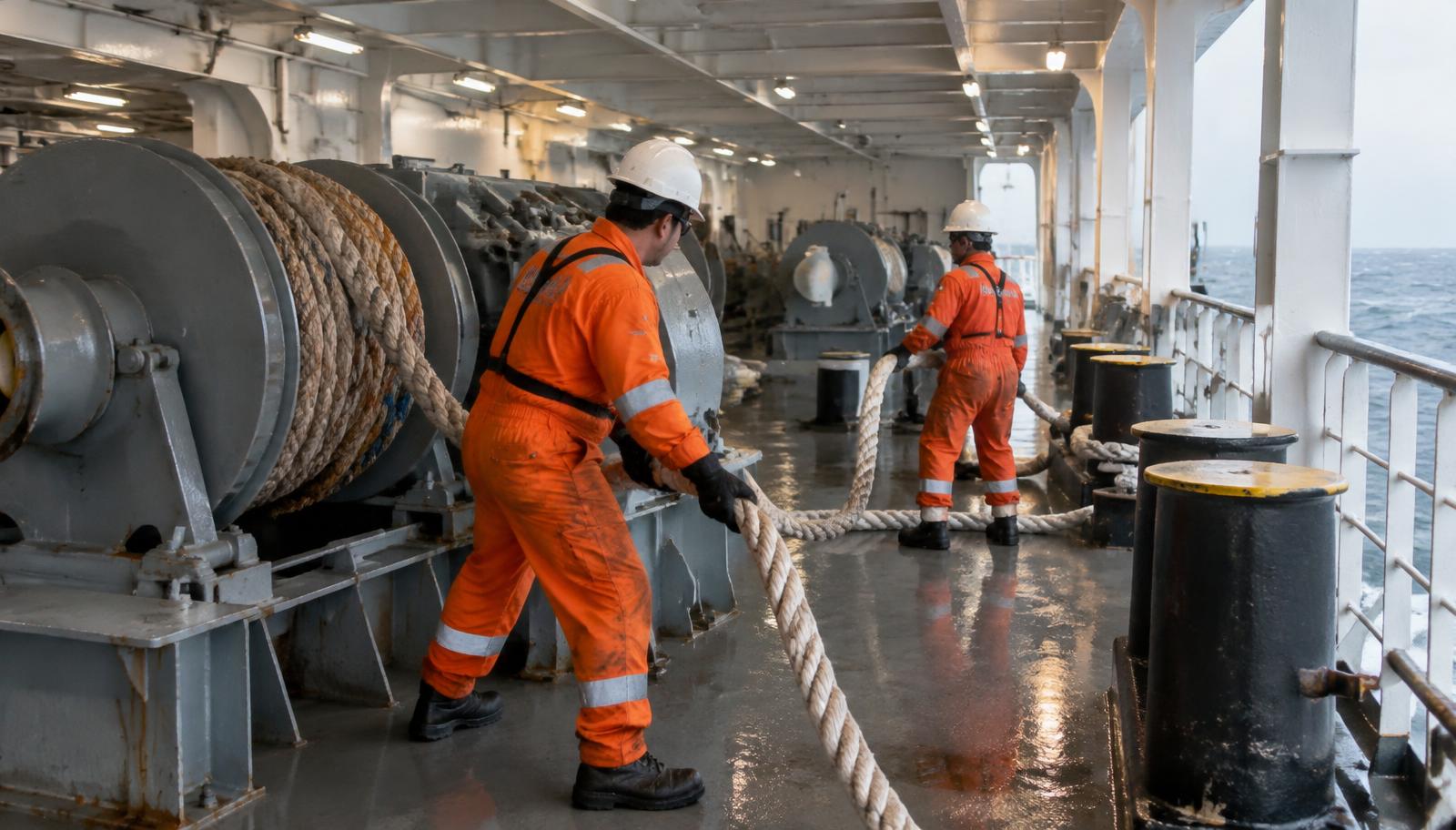
If you work on a ship, the rules for an on-the-job injury are different from New Jersey workers' compensation. Seamen have three federal remedies: the Jones Act, maintenance and cure, and unseaworthiness. This applies to cruise crew, and to New Jersey and New York residents working on ferries, tugs, barges and other vessels in the harbor.
The short answer
- The Jones Act lets a seaman sue the employer for negligence (46 U.S.C. § 30104).
- Maintenance and cure means daily living expenses and medical care until you reach maximum recovery, regardless of fault.
- Unseaworthiness makes the vessel owner liable for an unsafe ship, gear or crew, even without negligence.
- The general deadline is 3 years (46 U.S.C. § 30106), but cruise crew contracts often require arbitration, sometimes abroad.
Are you a "seaman"?
These remedies are for seamen, not everyone who works near water. The Supreme Court's test asks whether your duties contribute to the vessel's function or mission, and whether you have a substantial connection to a vessel or fleet in navigation, both in duration and nature (Chandris, Inc. v. Latsis, 515 U.S. 347 (1995)). As a rule of thumb, workers who spend less than about 30% of their time on a vessel in navigation usually don't qualify.
Cruise ship cabin stewards, cooks, entertainers, deckhands and officers are often seamen. Port workers who load provisions or baggage at Cape Liberty or Red Hook usually aren't. They are typically covered by the Longshore and Harbor Workers' Compensation Act instead (33 U.S.C. § 901 and following), which also allows a negligence claim against a vessel owner in some situations (33 U.S.C. § 905(b)).
Remedy 1: Jones Act negligence
A seaman can sue the employer when the employer's negligence played any part, even the slightest, in causing the injury. That's a lighter causation standard than in ordinary injury cases. Examples: understaffing, inadequate training, pressure to work while exhausted, no help lifting heavy loads, or ignored safety complaints.
Remedy 2: Maintenance and cure
An employer must pay an injured or ill seaman maintenance (a daily amount for food and lodging) and cure (medical treatment) until the seaman reaches maximum medical improvement. Fault doesn't matter, and the illness or injury only has to arise while the seaman is in service of the ship.
If an employer willfully refuses to pay, the seaman can recover attorney's fees (Vaughan v. Atkinson, 369 U.S. 527 (1962)) and punitive damages (Atlantic Sounding Co. v. Townsend, 557 U.S. 404 (2009)).
Remedy 3: Unseaworthiness
A vessel owner must provide a ship reasonably fit for its intended use, including its equipment, procedures and crew. A slippery deck without non-skid coating, a broken winch or a crew too small for the job can make a ship unseaworthy. Liability doesn't depend on negligence, but punitive damages aren't available for unseaworthiness (The Dutra Group v. Batterton, 588 U.S. 358 (2019)).
Arbitration in cruise crew contracts
Many cruise line employment contracts require crew to arbitrate injury claims, often in another country and sometimes under foreign law. Federal courts in the Eleventh Circuit have generally enforced those clauses under the New York Convention on foreign arbitral awards (Bautista v. Star Cruises, 396 F.3d 1289 (11th Cir. 2005); Lindo v. NCL (Bahamas), Ltd., 652 F.3d 1257 (11th Cir. 2011)). Read your contract and get advice before signing any settlement or release.
Jones Act vs. New Jersey workers' comp
Land-based workers in New Jersey generally can't sue their employers and receive no-fault benefits under the Workers' Compensation Act (N.J.S.A. 34:15-1 and following). Seamen are different: they get no-fault maintenance and cure plus the right to sue for negligence and unseaworthiness. Getting this classification right is critical. See how New Jersey workers' compensation works for the land rules.
Steps after a shipboard work injury
- Report the injury to your supervisor in writing and get a copy of the accident report.
- Get medical care and keep every record and receipt.
- Write down witnesses' names and what happened while it's fresh.
- Don't sign a release or give a recorded statement before getting advice.
Frequently asked questions about the Jones Act
Does the Jones Act cover cruise ship crew?
Often, yes. Crew who work aboard and spend a substantial part of their time on the ship usually qualify as seamen. Whether a foreign-flagged cruise line's crew can bring a U.S. Jones Act claim, or must arbitrate under foreign law, depends on the employment contract and the facts.
How long do I have to file a Jones Act claim?
Generally 3 years from the injury (46 U.S.C. § 30106). A crew contract can set different procedures, such as arbitration, so check it right away.
Can I get maintenance and cure even if the accident was my fault?
Usually yes. Maintenance and cure doesn't depend on fault, though it can be denied in narrow situations, such as an injury caused by the seaman's own willful misconduct.
Is a Jones Act claim the same as workers' compensation?
No. Workers' comp is no-fault and generally bars suing the employer. The Jones Act lets a seaman sue the employer for negligence, on top of maintenance and cure.
More on maritime injury claims: cruise ship and maritime injury lawyer.
General information, not legal advice. Seaman status and arbitration questions depend closely on the facts and the employment contract.