
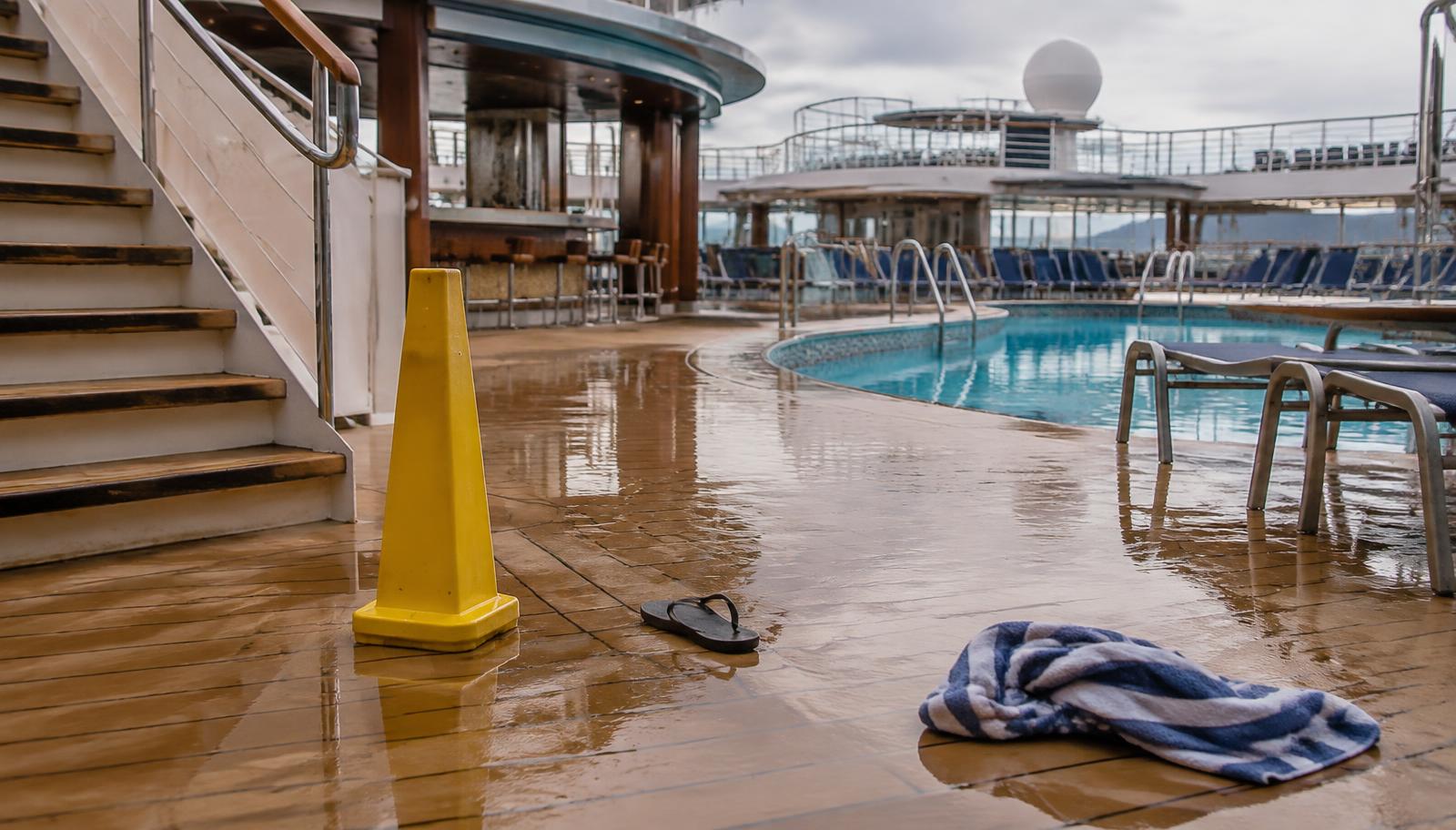
Slips and falls are among the most common cruise injuries: pool decks wet from swimmers and rain, polished stairs, buffet floors with spilled food and drinks. Whether the cruise line pays depends on federal maritime law, and its rule is different from New Jersey's.
The short answer
- A cruise line owes passengers reasonable care under the circumstances (Kermarec v. Compagnie Generale Transatlantique, 358 U.S. 625 (1959)).
- To win, you usually must show the line knew or should have known about the dangerous condition (Keefe v. Bahama Cruise Line, 867 F.2d 1318 (11th Cir. 1989)).
- Prior similar falls, warning signs, cleaning logs and video can prove that notice.
- Most tickets require written notice within 6 months and suit within 1 year.
Maritime law, not New Jersey premises law
A fall in a Bayonne supermarket is governed by New Jersey premises-liability law. A fall on a ship at sea is governed by federal general maritime law, even if the ship sailed from New Jersey. The cruise line isn't automatically responsible because you fell. The question is whether it acted reasonably.
Most passenger cruise cases are decided in federal court in Miami under Eleventh Circuit precedent, because tickets usually require suit there. That court's notice rule is the one to plan around.
The notice requirement
Under Keefe, a cruise line is liable for a dangerous condition only if it had actual or constructive notice of it, unless the line created the hazard itself. You can show notice by:
- Actual notice: a crew member saw the spill, a passenger reported it, or the line knew the surface was slippery when wet.
- Constructive notice: the hazard existed long enough that the crew should have found it, or substantially similar falls had happened in the same spot or on the same kind of surface.
- Warning signs: the Eleventh Circuit has held that a cruise line's own warning sign can be evidence it knew about the danger (Guevara v. NCL (Bahamas) Ltd., 920 F.3d 710 (11th Cir. 2019)).
Cruise lines also argue that a hazard was open and obvious. Courts look at whether a reasonable passenger would have seen it; a clear puddle on a shiny deck may not be obvious at all.
Where falls tend to happen on ships
- Pool and lido decks: water tracked from pools and hot tubs, especially on smooth tile or painted steel.
- Exterior decks in rain or spray: wind and wet teak or composite decking.
- Stairs: polished treads, missing or worn non-slip strips, uneven step heights, poor lighting in theaters.
- Buffets and bars: spilled food, ice and drinks during busy service.
- Cabin bathrooms: raised thresholds and slick shower floors.
- Gangways and tenders: see tender boat and gangway accidents.
Evidence that wins or loses these cases
Cruise ships are full of cameras. Federal law requires ships covered by the Cruise Vessel Security and Safety Act to keep video surveillance systems (46 U.S.C. § 3507(b)), but footage can be recorded over quickly. A preservation letter should go out as early as possible. Also important:
- Photos of the exact spot, your shoes, any water or debris and any warning sign (or lack of one).
- Names and cabin numbers of witnesses.
- The onboard incident report and the ship's medical records.
- Later, in a lawsuit: cleaning logs, prior incident reports for the same area and slip-resistance testing by an expert.
Use our cruise injury evidence checklist.
Partly at fault?
Maritime law uses pure comparative fault. If you were partly careless, for example, running on a wet deck, your recovery is reduced by your share of fault but not barred. That's different from New Jersey's land rule, which bars recovery if you're more than 50% at fault (N.J.S.A. 2A:15-5.1). See New Jersey comparative negligence for the land version.
Deadlines and court
Expect your ticket to require written notice within 6 months and a lawsuit within 1 year, in a specific court (46 U.S.C. § 30526). See cruise injury claim deadlines and why your ticket says Miami. Cases filed in another state's court may be handled with co-counsel admitted there.
More on passenger rights: cruise ship injury lawyer.
General information, not legal advice. Outcomes depend on the facts, the ticket contract and the court that hears the case.